SPECIAL PROGRAM: THE SMART SEA OF PERU, BOLIVIA, PARAGUAY AND BRAZIL
The Smart Sea: Strategic Integration of Four Nations
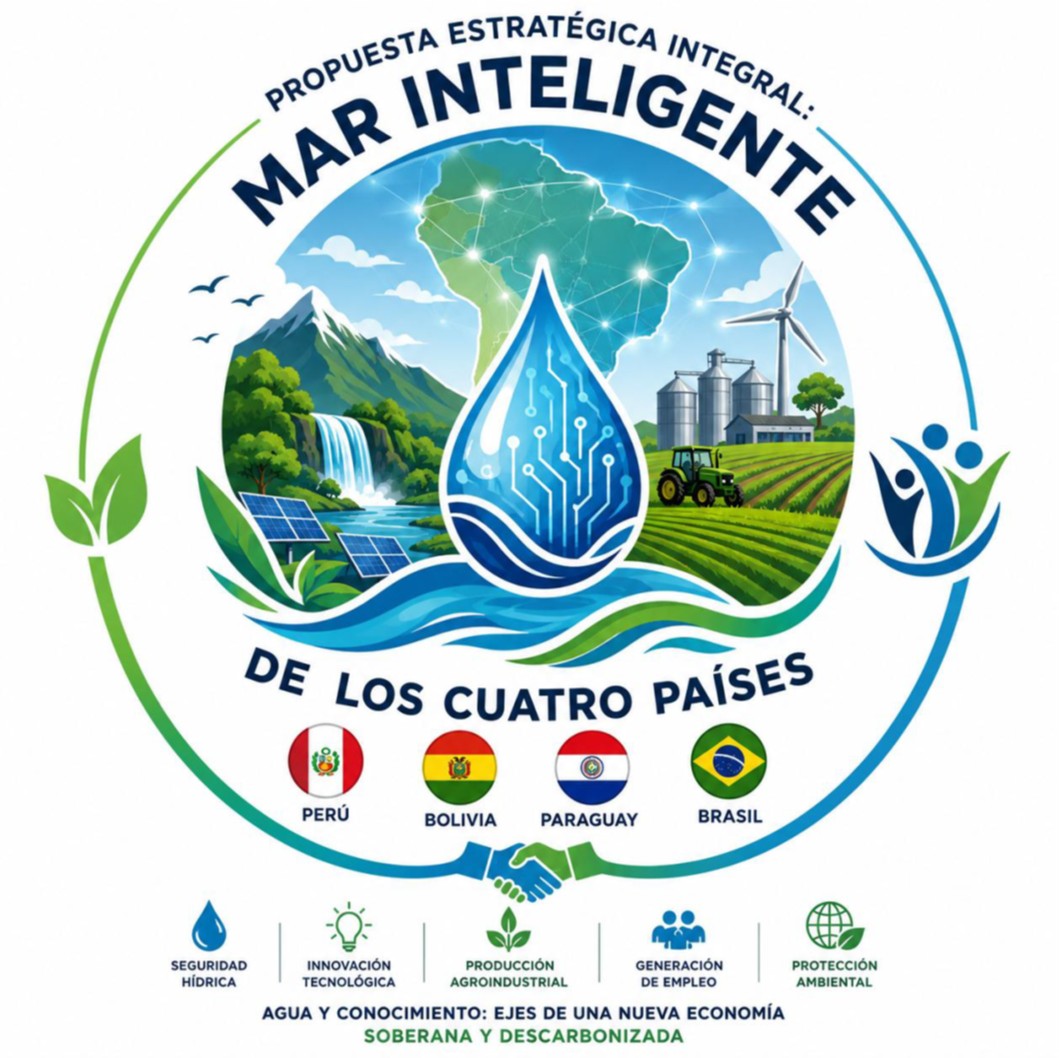
The Smart Sea of the Four Countries is a large-scale strategic initiative designed to transform the economies of Peru, Bolivia, Paraguay, and Brazil between 2026 and 2038. This program seeks to transition these nations from traditional raw material extraction to a sovereign knowledge economy powered by technological innovation and sustainable infrastructure. Key pillars include the construction of massive hydroelectric dams, the production of green hydrogen, and the implementation of blockchain-based financial tokenization backed by gold reserves to reduce national debt. Furthermore, the proposal emphasizes mass educational reform through AI-driven platforms and STEM training to prepare millions of citizens for new "green" jobs. By integrating regional logistics and resources, the project aims to establish this four-country bloc as a global leader in clean energy and environmental preservation. Ultimately, the sources outline a roadmap for achieving regional prosperity through smart water management, eco-efficient mining, and digital sovereignty.
1. EXECUTIVE SUMMARY
1.1 Program Identification
| Field | Description |
|---|---|
| Program Name | "El Mar Inteligente de los Cuatro Paises" (The Smart Sea of the Four Countries) |
| Participating Nations | Peru, Bolivia, Paraguay, and Brazil |
| Implementation Period | 2026-2038 |
| Promoters | Ing. José Manuel Oliden Quiroz (President, Oro Azul) / Lic. Richard Solano Pinto (President, F-TESIS Foundation) |
| Strategic Focus | Transition from extractive economies to knowledge-based and technological sovereignty economies |
1.2 Vision and Strategic Objectives
The "Smart Sea" program constitutes a multidimensional structural transformation initiative designed to resolve the "South American Paradox": nations possessing the world's most abundant natural resources (water, sun, wind) yet remaining 70% dependent on imported fossil fuels and trapped in cycles of external debt.
Fundamental Objectives:
1. Water and Energy Sovereignty: Integrated management of water resources and transition toward a "green molecules" economy (Green Hydrogen - H2V)
2. Financial Sovereignty: Reduction of national external debt by 15% to 25% through tokenization of gold reserves ("Digital Alchemy")
3. Technological Sovereignty: Implementation of Industry 4.0 (Blockchain, AI, Digital Twins, IoT) for intelligent infrastructure management
4. Human Capital 4.0: Massive STEM training with linguistic justice (Quechua, Aymara, Guarani) to generate millions of "green" jobs
1.3 Key Program Dimensions
| Indicator | Value |
|---|---|
| Estimated Investment per Country | USD 15-30 billion |
| Implementation Horizon | 2026-2038 (12 years) |
| Total Job Creation | ~39 million positions (direct and indirect) |
| Regional GDP Growth | 2.5% - 10% |
| Social Return on Investment (SROI) | 18:1 |
| External Debt Reduction | 15% - 25% in 10 years |
| CO₂ Mitigation | 3.5 million tons/year |
| Agricultural Productivity Increase | Up to 80% through IoT-managed technified irrigation |
1.4 Job Creation by Country
| Country | Jobs Generated (Direct and Indirect) |
|---|---|
| Peru | 14,800,000 |
| Bolivia | 6,280,160 |
| Brazil | 12,183,000 |
2. GENERAL TECHNICAL FACT SHEET
2.1 Strategic Pillars of the Program
| Pillar | Key Components | Enabling Technologies |
|---|---|---|
| Water and Energy | Multifunctional dams, Paraguay-Parana Waterway, H2V Plants | SCADA, Digital Twins, IoT, IEC 61850 |
| Sovereign Finance | RWA Tokenization (Gold), Green Bonds | Hybrid Blockchain, LBMA Standards |
| Sustainable Mining | Surgical Mining, Blue Amazon | Satellite Magnetometry, Bioleaching |
| Habitat and Smart Cities | 3D Housing, Smart Cities | 3D Printing, Nanotechnology, IEC 61850 |
| Human Capital | Education 4.0, Blockchain Certifications | MOOCs, Starlink, Kolibri, ISO/IEC 40180 |
2.2 Water Infrastructure by Country
| Country | Infrastructure | Irrigation Area | Energy Capacity |
|---|---|---|---|
| Peru | 210 multifunctional dams | 3.5 million ha | 9,000 MW |
| Bolivia | 148 new dams | 1.5 million ha | 14,000 MW |
| Paraguay | 62 new dams | Expanded technified irrigation | Climate resilience |
| Brazil | 210 multifunctional dams | 5.5 million ha | 9,000 MW |
| TOTAL | 630+ dams | >10 million ha | ~32,000 MW |
2.3 Green Hydrogen (H2V) - 2038 Production Targets
| Country | Annual Production (tons) |
|---|---|
| Peru | 432,782 |
| Brazil | 370,956 |
| Paraguay | 185,478 |
| Bolivia | (in development) |
| TOTAL | >1,000,000 tons/year |
2.4 Electrolysis Technologies
| Technology | Role | Application |
|---|---|---|
| PEM (Proton Exchange Membrane) | "The Sprinter" – rapid response to intermittency | Solar/Wind variability management |
| Alkaline | "The Marathoner" – robust, lower CAPEX | Industrial base load sustenance |
3.1 Gold Reserve Tokenization (RWA)
| Country | Gold Reserves (tons) | Standard |
|---|---|---|
| Peru | 620 | LBMA Certified |
| Bolivia | 410 | LBMA Certified |
| Paraguay | 222 | LBMA Certified |
| Brazil | 222 | LBMA Certified |
| TOTAL | 1,474 tons | 1:1 Token = 1 Gram of Gold |
3.2 Tokenization Mechanism
| Component | Description |
|---|---|
| Parity | 1 Token = 1 gram of LBMA-certified physical gold |
| Platform | Hybrid Blockchain (private for sovereignty, public for auditing) |
| Generated Liquidity | Immediate capital without physical asset sale |
| Debt Reduction | 15% - 25% over 10-year horizon |
| Capital Market | Sovereign capital market immune to global inflation |
3.3 Financing Structure
| Source | Role |
|---|---|
| IDB, CAF, World Bank | Foundational infrastructure financing |
| BRICS | Emerging market capital (geopolitical diversification) |
| Ethical Funds (Vatican Bank) | Capital aligned with ESG objectives |
| PPP (Public-Private Partnerships) | Efficiency in H2V plant and Smart City construction |
| Green Bonds | Debt instruments for environmental projects |
4. SUSTAINABLE MINING FACT SHEET
4.1 Surgical Mining
| Component | Technology / Method | Impact |
|---|---|---|
| Precision Prospecting | Satellite Magnetometry + AI | Millimeter-precision identification of mineral anomalies |
| Mercury Elimination | Bioleaching (bacteria) + Gravimetric separation | 90% reduction in mercury use |
| Digital Passport | Blockchain for traceability | "Conflict-free" certification, up to 35% price premium |
| Blue Amazon | Marine sediment extraction + ecological cleanup | Coastal ecosystem restoration |
4.2 Applicable Standards
| Standard | Application |
|---|---|
| GISTM | Tailings management and environmental accountability |
| OECD Due Diligence | Mineral traceability |
| LBMA | Precious metals standards |
5. HABITAT AND SMART CITIES FACT SHEET
5.1 3D Printed Housing
| Component | Specification |
|---|---|
| Technology | 3D Concrete Printing + Nanotechnology |
| Unit Size | 200m² |
| Construction Time | 1-3 weeks |
| Cost (CAPEX) | $40,000 USD per unit |
| Cost per m² | $70 - $190 USD/m² (vs. market $500/m²) |
| Cost Reduction | 50% - 75% |
| Zero Waste | Industrial construction without waste |
5.2 Smart Grids and Smart Cities
| Component | Technology | Benefit |
|---|---|---|
| Electrical Networks | IEC 61850 (Smart Grids) | Bidirectional energy management |
| Urban Energy Arbitrage | Automated demand management | 30% reduction in municipal expenditure |
| IoT | Sensor networks in wells, dams, agricultural modules | Remote telemetry and automated management |
| Digital Twins | Virtual infrastructure replicas | Real-time monitoring and simulation |
6. HUMAN CAPITAL AND EDUCATION 4.0 FACT SHEET
6.1 Training Goals
| Country | Population to Train |
|---|---|
| Peru | 4,500,000 |
| Bolivia | 2,500,000 |
| Paraguay | 1,500,000 |
6.2 Training Levels
| Level | Population | Focus |
|---|---|---|
| Primary/Secondary | 3.5M+ | Digital literacy and "Water Culture" |
| Specialized Technical | 1.5M+ | Certification in H2V operation and precision mechanics |
| Bachelor's/Postgraduate | 0.5M+ | Advanced research (computational hydraulics, nanomedicine) |
6.3 Educational Platform
| Component | Technology | Feature |
|---|---|---|
| Courses | AI-adaptive MOOCs | STEM and water resources training |
| Languages | Quechua, Aymara, Guarani, Spanish, Portuguese | Linguistic Justice |
| Certifications | Blockchain (Open Badges v2.1) | Unalterable micro-credentials, verifiable via QR |
| Rural Connectivity | Starlink + Kolibri platform | Offline access in Amazon and Chaco |
| Zero Rating | Telecom operator alliances | Free data for students |
7.1 Institutional Structure
| Entity | Function |
|---|---|
| High-Level Institution (ATSAS Model) | Alignment of regulatory frameworks across 4 nations |
| Sectoral Technical Committees | Synchronization of norms for energy, education, and surgical mining |
| Multilateral Audit | Blockchain-verified oversight of financial milestones and KPIs |
7.2 International Standards Applied
| Standard | Application |
|---|---|
| ISO 55001 | Asset management (transboundary infrastructure) |
| ISO 27001 | Data security (critical infrastructure protection) |
| ISO 22734 | Sustainable water desalination |
| ISO 19880 | Hydrogen compression/storage safety (350-700 bar) |
| ISO/IEC 40180 | Quality and global validity of educational certifications |
| IEC 61850 | Smart Grids and intelligent electrical networks |
| NTE E.030 | Seismic security for Andean infrastructure |
| GISTM | Mining tailings management |
8. ENVIRONMENTAL AND SOCIAL IMPACT FACT SHEET
8.1 Environmental Mitigation
| Indicator | Target |
|---|---|
| CO₂ Reduction | 3.5 million tons/year |
| Equivalent | Removal of 1.2 million gasoline cars |
| Mercury Reduction | 90% in mining (bioleaching) |
| Reforestation | Compensation programs in affected ecosystems |
8.2 Social Indicators
| Indicator | Value |
|---|---|
| Social Return on Investment (SROI) | 18:1 ($1 invested = $18 in social benefit) |
| Agricultural Productivity Increase | Up to 80% through IoT irrigation |
| Internet Access | Starlink coverage + Offline (Kolibri) for remote areas |
| Dignified Housing | 200m² with energy efficiency standards |
9. ROADMAP: 2026 – 2038
| Phase | Period | Key Activities |
|---|---|---|
| Phase 1 | 2026-2028 | Diplomatic agreements, treaty ratification, financial structuring, educational platform launch |
| Phase 2 | 2028-2032 | Initiation of water infrastructure construction, H2V plants, Smart Grid implementation |
| Phase 3 | 2032-2035 | First turbine operations, initial H2V production, gold reserve tokenization |
| Phase 4 | 2035-2038 | Full commercial operation, mass H2V production, 15-25% debt reduction |
10. ANNEX: GLOSSARY OF KEY TERMS
| Term | Definition according to the Program |
|---|---|
| Digital Alchemy | Process of tokenizing physical assets (gold) on blockchain to generate sovereign liquidity |
| Blue Amazon | Extraction of minerals from marine sediments with ecological microplastic cleanup |
| Bioleaching | Use of bacteria to process minerals, reducing 90% of mercury |
| Blockchain | Immutable digital ledger for educational certification and mineral traceability |
| Digital Passport | Blockchain record guaranteeing "conflict-free" mineral origin |
| Digital Twin | Virtual infrastructure replica for real-time monitoring and simulation |
| H2V (Green Hydrogen) | Energy vector produced by electrolysis with 100% renewable energy |
| IEC 61850 | Standard for Smart Grids and intelligent electrical networks |
| IoT | Internet of Things; sensor network for remote telemetry |
| Kolibri | Offline educational platform for areas without internet connection |
| LBMA | London Bullion Market Association; precious metals standard |
| LCOH | Levelized Cost of Hydrogen; hydrogen production cost |
| Satellite Magnetometry | AI technology to identify mineral anomalies with millimeter precision |
| MOOC | Massive Open Online Courses; mass training platform |
| PEM | Proton Exchange Membrane; rapid-response electrolysis ("the sprinter") |
| RWA | Real-World Assets; tokenization of physical assets |
| SCADA | Supervisory Control and Data Acquisition; real-time monitoring |
| SROI | Social Return on Investment; social investment return (18:1) |
| Starlink | Satellite internet for rural connectivity |
| Zero Rating | Free data for educational applications |
11. COMPARATIVE SUMMARY: OLD MODEL vs. SMART SEA MODEL
| Factor | Old Model (Extractive Economy) | Smart Model (Digital Alchemy) |
|---|---|---|
| Economic Position | Nations are "price takers" of commodities | Nations are "price makers" of clean energy |
| Debt Management | Debt paid by selling physical resources | Gold tokenized (RWA) to create sovereign credit |
| Education | Diplomas vulnerable to fraud | Skills verified via Open Badges on Blockchain |
| Mineral Supply Chains | Opaque and unethical | "Digital Passports" ensure 100% ethical traceability |
| Housing | Generic units; high waste ($500/m²) | Standardized 200m² units ($70-190/m² via 3D printing) |
| Mining | High mercury contamination | 90% mercury reduction via bioleaching |
| Energy Management | Manual/Passive | Smart Grids (IEC 61850): 30% reduction in municipal waste |
| Hydrogen Production | Carbon-intensive | PEM (Sprinter) for variable loads; Alkaline (Marathoner) for base load |
EXECUTIVE VISION
The Smart Sea of the Four Countries Program is a multinational strategic initiative designed to transform South America's vast water, energy, mineral, technological, and human resources into a sustainable development platform capable of generating prosperity, competitiveness, energy security, and technological sovereignty.
The program integrates large-scale water infrastructure, renewable energy, green hydrogen production, digital transformation, sustainable mining, smart cities, and Education 4.0 into a single regional development model.
Strategic Motto
"Transforming Water, Energy, and Knowledge into Prosperity for Future Generations."
1. PROGRAM IDENTIFICATION
| Item | Description |
|---|---|
| Program Name | The Smart Sea of the Four Countries |
| Participating Nations | Peru, Bolivia, Paraguay, Brazil |
| Implementation Period | 2026–2038 |
| Promoters | Ing. José Manuel Oliden Quiroz / Lic. Richard Solano Pinto |
| Strategic Focus | Sustainable Development, Energy Security, Water Security, Technological Sovereignty |
| Geographic Scope | South American Regional Integration |
2. STRATEGIC OBJECTIVES
Water Sovereignty: Integrated watershed management. Construction of multifunctional reservoirs and hydraulic infrastructure. Expansion of precision irrigation systems. Climate resilience and drought mitigation.
Energy Sovereignty: Development of Green Hydrogen (H₂V). Renewable energy integration. Smart Grid deployment. Energy storage and flexibility solutions.
Financial Sovereignty: Development of innovative financing mechanisms. Green Bonds and Climate Finance. Digital asset infrastructure and tokenized real-world assets (RWA). Diversification of sovereign funding sources.
Technological Sovereignty: Artificial Intelligence. Blockchain. Digital Twins. Internet of Things (IoT). Advanced satellite monitoring systems.
Human Capital 4.0: Large-scale STEM education. Technical and vocational training. Research and innovation ecosystems. Multilingual digital inclusion.
3. STRATEGIC IMPACT INDICATORS
| Indicator | Target |
|---|---|
| Estimated Investment per Country | USD 15–30 Billion |
| Program Horizon | 12 Years |
| Regional Employment Generation | Millions of Direct and Indirect Jobs |
| Regional GDP Growth Potential | 2.5%–10% |
| Social Return on Investment (SROI) | Up to 18:1 |
| CO2 Emission Reduction | 3.5 Million Tons/Year |
| Agricultural Productivity Increase | Up to 80% |
| Renewable Energy Capacity | Approximately 32 GW |
| Irrigated Agricultural Area | More than 10 Million Hectares |
4. STRATEGIC PILLARS
Pillar I: Water and Energy Infrastructure
Components: Multipurpose dams. Water storage systems. Regional water corridors. Green Hydrogen production plants. Smart electrical networks.
Reference Standards: ISO 55001 Asset Management. ISO 14001 Environmental Management. IEC 61850 Smart Grids. ISO 50001 Energy Management.
Expected Benefits: Increased water security. Renewable energy expansion. Enhanced agricultural productivity. Reduced climate vulnerability.
Pillar II: Green Hydrogen Economy
Production Target by 2038: More than 1 Million Tons of Green Hydrogen annually.
Electrolysis Technologies:
PEM Electrolysis – "The Sprinter": Fast response to intermittent renewable generation. Ideal for solar and wind integration. High operational flexibility.
Alkaline Electrolysis – "The Marathon Runner": Lower capital expenditure. Long operational lifespan. Reliable baseload production.
Target Hydrogen Cost: LCOH: USD 3.5 - 5.0/kg
Pillar III: Sustainable Mining Transformation
Key Technologies: Satellite remote sensing. AI-assisted geological analysis. Precision magnetometry. Bioleaching technologies. Blockchain traceability.
Environmental Targets: Up to 90% reduction in mercury usage. Improved recovery rates. Enhanced environmental compliance.
International Standards: GISTM. OECD Due Diligence Guidance. ISO 14001. LBMA Responsible Gold Guidance.
Pillar IV: Smart Cities and Housing
Smart Housing Program: 3D-printed housing. Energy-efficient designs. Sustainable urban development.
Technical Parameters:
| Item | Specification |
|---|---|
| Average Unit Size | 200m² |
| Construction Time | 1-3 Weeks |
| Estimated Cost | USD 40,000 per Unit |
| Waste Reduction | Up to 90% |
Smart City Technologies: IoT sensors. Smart metering. Digital Twins. Predictive maintenance. Automated energy management.
Pillar V: Education 4.0 and Human Capital
Training Targets: Millions of citizens trained across the four countries.
Educational Areas: Green Hydrogen Operations. Renewable Energy Systems. Artificial Intelligence. Advanced Manufacturing. Precision Agriculture. Water Resources Management.
Digital Learning Ecosystem: AI-adaptive MOOCs. Blockchain Certifications. Satellite Connectivity. Offline Learning Platforms.
Standards: ISO/IEC 40180. Open Badges 2.1. UNESCO Digital Learning Guidelines.
5. FINANCING ARCHITECTURE
| Source | Purpose |
|---|---|
| Multilateral Development Banks | Core Infrastructure |
| Development Funds | Climate Projects |
| Public-Private Partnerships (PPP) | Industrial Projects |
| Green Bonds | Sustainable Investments |
| ESG Funds | Social and Environmental Programs |
| Sovereign Investment Mechanisms | Strategic Long-Term Capital |
Key Financial Indicators: IRR (Internal Rate of Return): Target >12%. NPV Positive Across Strategic Components. Debt Service Coverage Ratio >1.5. Social Return on Investment (SROI): Up to 18:1.
6. GOVERNANCE FRAMEWORK
Regional High-Level Council: The program proposes a multinational governance mechanism composed of: Ministries of Finance. Ministries of Energy. Ministries of Environment. Ministries of Education. Development Banks. Universities. Private Sector Representatives. International Partners.
Responsibilities: Strategic alignment. Regulatory harmonization. Program supervision. Transparency and auditing. KPI monitoring.
7. RISK MANAGEMENT AND MITIGATION
| Risk | Mitigation Strategy |
|---|---|
| Regulatory Delays | Bilateral and Multilateral Framework Agreements |
| Financial Volatility | Diversified Financing Portfolio |
| Environmental Impacts | Comprehensive ESIAs and Monitoring |
| Technology Risks | ISO 27001 Cybersecurity Framework |
| Social Risks | Stakeholder Engagement Programs |
| Climate Risks | Resilient Infrastructure Design |
8. IMPLEMENTATION ROADMAP
Phase I (2026-2028): Diplomatic agreements. Feasibility studies. Financial structuring. Institutional framework.
Phase II (2028-2032): Infrastructure construction. Education platform deployment. Smart Grid implementation.
Phase III (2032-2035): Initial operations. Green Hydrogen production. Regional digital integration.
9. ENVIRONMENTAL AND SOCIAL IMPACT
Environmental Targets: 3.5 million tons of CO₂ reduction annually. Reforestation and ecosystem restoration programs. Cleaner mining technologies. Sustainable water management.
Social Targets: Millions of jobs created. Expanded digital inclusion. Improved rural connectivity. Affordable and resilient housing.
10. POSITIVE STRATEGIC MESSAGES
Vision Statements: "Water is the new strategic resource of the 21st century, and cooperation is the key to unlocking its value."
1. Review Quiz: Short-Answer Questions
Instructions: Answer the following ten questions based on the provided technical and strategic documentation. Each response should be between 2 and 3 sentences.
1. What is the central concept of "El Mar Inteligente" and what regional paradox does it seek to resolve?
2. Describe the technical differences and strategic uses of PEM versus Alkaline electrolysis within the "Mi Planta de Hidrogeno" initiative.
3. What is "Surgical Mining" (Mineria Quirúrgica) and how does it aim to change environmental standards in the extractive sector?
4. How does the program utilize Real-World Asset (RWA) tokenization to achieve financial sovereignty?
5. What are the specific logistical and energetic goals of the Trinational Dam (Bolivia-Paraguay-Brazil)?
6. Explain the role of 3D concrete printing and nanotechnology in the "Mi Vivienda" social housing program.
7. How does the educational pillar (Chapter I) plan to reach rural and indigenous populations in terms of language and connectivity?
8. What is the "Amazonia Azul" concept and how does it relate to mineral extraction?
9. According to the program's projections, what is the estimated impact on job creation and GDP for the participating nations?
10. How does the program use Blockchain technology to ensure the integrity of educational certifications and mineral traceability?
II. Answer Key
1. Concept and Paradox: The program recognizes water as the most valuable asset of the 21st century and the core driver of sustainable development. It seeks to resolve the "South American paradox," where nations possess the world's most abundant natural resources (sun, wind, and water) yet remain 70% dependent on imported fossil fuels and cycles of external debt.
2. Electrolysis Technologies: Proton Exchange Membrane (PEM) technology is used as a "sprinter" to respond rapidly to the intermittency of solar and wind energy. Conversely, Alkaline electrolysis serves as the "marathoner," providing a cost-effective solution for sustaining high-volume, continuous industrial base loads.
3. Surgical Mining: This model uses geointelligence and satellite magnetometry to identify mineral anomalies with millimeter precision, thereby minimizing surface impact. Its primary environmental goals include eliminating 90% of mercury use and remediating historical environmental liabilities through biotechnology like bioleaching.
4. RWA Tokenization: The states digitalize physical gold reserves (under LBMA standards) on a hybrid blockchain where one token equals one gram of certified gold. This "digital alchemy" generates immediate liquidity and is projected to reduce national external debt by 15% to 25% without the immediate need to physically sell the resource.
5. Trinational Dam: This 5,000 MW megaproject is designed to generate clean energy and improve the navigability of the Paraguay-Paraná Waterway. Its most critical logistical impact is granting Bolivia sovereign access to the Atlantic Ocean throughout the entire year.
6. 3D Printing and Nano-Housing: The program uses industrial 3D concrete printing to build houses in one to three weeks with zero waste, significantly reducing costs by 50% to 75%. Nanotechnology is applied to construction blocks for superior thermal insulation, while the structures operate under the IEC 61850 standard to integrate with Smart Grids.
7. Rural Education and Inclusion: The program provides bilingually adapted MOOCs (Spanish-Guarani, Quechua, and Aymara) and uses Starlink satellite internet for remote access. For areas without a constant signal, the Kolibri platform allows for offline educational content, complemented by "zero-rating" alliances with telecommunications operators.
8. Amazonia Azul: This concept involves the extraction of gold and critical minerals from coastal and marine areas while simultaneously performing an ecological cleanup of microplastics and contaminated sediments. The goal is to transform extractive activity into a system of coastal ecosystem restoration.
9. Socioeconomic Impact: The program projects a regional GDP increase of 2.5% to 10% and the generation of millions of "green" jobs: 14.8 million in Peru, 12.1 million in Brazil, 6.2 million in Bolivia, and 5.8 million in Paraguay. This includes a specialized elite of engineers and technicians trained specifically for the new hydrogen and water infrastructure.
10. Blockchain Integrity: Blockchain issues unalterable micro-credentials (Open Badges v2.1) that allow employers to verify academic competencies via QR codes, preventing fraud. For minerals, it creates a "Digital Passport" that guarantees a "conflict-free" origin and total traceability under global OECD and LBMA standards.
III. Suggested Essay Topics
- The Transition from "Price Taker" to "Price Maker": Analyze how the production of Green Hydrogen and the tokenization of natural capital allow South American nations to dictate global energy prices rather than reacting to international fossil fuel volatility.
- Industry 4.0 as a Tool for Social Justice: Discuss the potential for Starlink, Blockchain-based certifications, and multilingual MOOCs to bridge the historical inequality gap in the rural Andes and Amazon regions.
- The Ethics of "Surgical Mining" and Environmental Remediation: Evaluate the feasibility of transforming the extractive sector into a "clean-up" mechanism for historical liabilities and microplastics, considering the technological requirements of magnetometry and bioleaching.
- Hybrid Financial Architectures and Sovereign Liquidity: Explore the implications of moving away from traditional IMF/World Bank debt models toward an architecture involving BRICS, ethical funds (e.g., Vatican Bank), and RWA tokenization.
- Energy Arbitrage and the Economy of Molecules: Assess the potential for the region to become a global hub for green ammonia and fertilizers, utilizing the low Levelized Cost of Energy (LCOE) provided by the program's massive hydroelectric and renewable investments.
IV. Glossary of Key Terms
| Term | Definition according to the Program |
|---|---|
| ABI / ABP | Research-Based Learning (postgraduate) and Program-Based Learning (undergraduate) educational methodologies. |
| Alquimia Digital | The process of using Blockchain to tokenize real-world physical assets (like gold) to generate sovereign liquidity. |
| BIM | Building Information Modeling; a methodology used to prevent cost overruns and ensure technical integrity in infrastructure projects. |
| Blockchain | A distributed ledger technology used for the unalterable certification of education and the "Digital Passport" of minerals. |
| CfD | Contract for Difference; a financial instrument used to guarantee price stability and "bankability" for green hydrogen producers. |
| Gemelo Digital | A virtual replica of physical infrastructure (dams or plants) used for real-time monitoring and simulation via SCADA/IoT. |
| Hidrógeno Verde (H2V) | An energy vector produced by splitting water molecules via electrolysis powered 100% by renewable sources. |
| IoT | Internet of Things; a network of sensors in wells, dams, and agricultural modules used for remote telemetry and automated management. |
| LCOH | Levelized Cost of Hydrogen; the program targets a competitive production range of 3.5 to 5.0 USD/kg. |
| MOOC | Massive Open Online Courses; the primary digital platform for training millions of citizens in STEM and sustainability. |
| RWA | Real-World Assets; the tokenization of physical resources (gold, water) into negotiable digital values without immediate physical sale. |
| SCADA | Supervisory Control and Data Acquisition; systems used for the real-time monitoring of critical infrastructure. |
| SROI | Social Return on Investment; a metric quantifying social benefit, estimated by the program at a ratio of up to 18:1. |
| Tarifa Cero | The practice of providing data-free internet access for specific educational applications to eliminate economic barriers for students. |
1. Strategic Vision and Governance
The program is led by Ing. Jose Manuel Olden Quiroz (President of Oro Azul) and Lic. Richard Solano Pinto (President of the F-TESIS Foundation). It operates on the premise that water and knowledge are the most valuable assets of the 21st century.
Governance Model: To ensure regional integration and bypass traditional political silos, the program proposes:
High-Level Institutional Framework: A governance structure similar to the proposed Trinational Environmental and Social Supervision Authority (ATSAS) to align regulatory frameworks across the four nations.
Global Standards: Adoption of international standards including ISO 55001 (assets), ISO 27001 (data), and ESG (Environmental, Social, and Governance) norms.
Immutable Oversight: Use of a hybrid Blockchain network for financial traceability and SROI (Social Return on Investment) auditing by multilateral organizations.
II. Economic Transformation: "Digital Alchemy"
The program introduces a revolutionary financial architecture to generate liquidity without increasing traditional debt or immediately selling physical resources.
Tokenization of Real-World Assets (RWA): The "Digital Alchemy" strategy involves digitizing physical gold reserves under LBMA (London Bullion Market Association) standards.
Mechanism: Tokens are issued on a 1:1 basis (1 Token = 1 gram of certified physical gold).
Regional Gold Reserves for Tokenization: Peru: 620 tons. Bolivia: 410 tons. Paraguay: 222 tons. Brazil: 222 tons (noted elsewhere as 84 tons in specific contexts).
Goal: Inject sovereign liquidity to reduce external debt by 15-25% within a decade and create a transparent, sovereign capital market.
Financing Architecture: The program projects an investment of $15,000 to $30,000 million USD per country, structured through: Public-Private Partnerships (APP). Credit lines from the IDB, CAF, World Bank, and BRICS bloc. Ethical funds, such as the Vatican Bank.
III. Technological and Infrastructure Pillars
1. Water Sovereignty and Logistics: Water is treated as the central strategic resource for food security and territorial development.
Trinational Dam: A flagship project between Bolivia, Paraguay, and Brazil designed to generate 5,000 MW. It will include locks to improve the navigability of the Paraguay-Parana Waterway, granting Bolivia sovereign access to the Atlantic Ocean.
National Infrastructure Targets:
| Country | Infrastructure Goal | Projected Impact |
|---|---|---|
| Peru | 210 multifunctional dams | Irrigation of 3.5M ha; 9,000 MW of energy |
| Bolivia | 148 new dams | Expansion of 1.5M ha of agriculture; 14,000 MW |
| Paraguay | 62 new dams | Climate resilience and technified irrigation |
| Brazil | 210 multifunctional dams | Irrigation of 5.5M ha; 9,000 MW of energy |
"Mi Pozo de Agua": Drilling thousands of deep wells equipped with solar pumps and telemetry for rural autonomy.
2. Green Hydrogen (H2V) and Energy Arbitrage: The program aims to end fossil fuel dependency (currently at 70%) by becoming a regional hub for "green molecules."
Production Targets: Aiming for over 1 million tons of clean molecules annually by 2038.
Electrolysis Technologies: PEM (Proton Exchange Membrane): Used for rapid response to intermittent solar and wind energy. Alkaline: Used for large-scale industrial base loads due to lower CAPEX.
Applications: Decarbonization of heavy industry, transport, and green fertilizer production.
Cost Efficiency: Targeted LCOH (Levelized Cost of Hydrogen) of $3.5-$5.0 USD/kg.
3. Smart Cities and Disruptive Housing: 3D Printed Housing: Construction of 200m² social housing units using 3D concrete printing and nanotechnology for thermal insulation.
Cost Reduction: Projected construction costs of $70-$190/m² (compared to market rates of $500/m², reducing overall costs by 50% to 75%).
Smart Grids: Deployment of networks under the IEC 61850 standard, allowing homes to act as nodes for urban energy arbitrage.
IV. Sustainable Industrial Evolution
"Surgical" Mining: The program seeks to redefine extraction through geointelligence and ethics:
Precision Prospecting: Use of AI and satellite magnetometry to identify mineral anomalies with millimeter precision, minimizing surface impact.
Mercury Eradication: Targeting a 90% reduction in mercury use through biotechnology (bioleaching) and gravimetric separation.
Digital Passport: Every gram of mineral will have a Blockchain-based "digital passport" to ensure ethical, conflict-free origins, allowing for price premiums of up to 35%.
"Amazonia Azul": Ecological cleaning of oceans and beaches while extracting gold and critical minerals from marine sediments.
V. Human Capital and Education 4.0
The program emphasizes the creation of a technical elite to manage the new infrastructure.
The Educational Platform: MOOC Ecosystem: Massively Open Online Courses powered by adaptive AI to train millions in STEM and water resources. Linguistic Justice: Content delivered in native languages, including Quechua, Aymara, and Guarani. Blockchain Micro-credentials: Issuance of unalterable certifications (Open Badges v2.1) to prevent institutional fraud. Rural Inclusion: Use of Starlink and the Kolibri platform for offline access in remote areas like the Amazon and the Chaco.
VI. Projected Socioeconomic Impact
Employment Generation: The program anticipates a historic mobilization of labor across the four nations: Peru: 14,800,000 jobs (including 160,000 specific green jobs). Bolivia: 6,280,160 jobs. Brazil: 12,183,000 jobs. Paraguay: 5,860,000 jobs.
Macroeconomic and Social Indicators: PIB (GDP) Growth: Projected regional increase between 2.5% and 10%. Social Return on Investment (SROI): Estimated at 18:1 (for every $1 invested in high-level research, $18 is returned in social benefits). Productivity: Agricultural productivity is expected to increase by up to 80% through technified irrigation and IoT. Environmental Impact: Mitigation of 3.5 million tons of CO2 annually (equivalent to removing 1.2 million gasoline cars from the road).
Key Concluding Insights
The document concludes with a provocative stance toward global markets: "Is the world truly prepared for a South America that has stopped exporting mineral earth to dictate the price of clean energy molecules and urban technology?" By 2038, the alliance intends to have transformed its external debt into productive investment, positioning itself as the primary strategic provider of sustainability and high-value molecules for both the South Pacific and the Atlantic.
How Four South American Nations are "Hacking" the Future: The Rise of the Smart Sea
South America is finally waking up to its own potential, shattering a historical paradox that has haunted the continent for centuries. For too long, the region has been a titan of natural wealth tethered to the chains of external debt, suffering a 70% dependency on imported fossil fuels while sitting on the world's most significant hydraulic and mineral reserves. This era of being a passive "price taker" is over.
Enter "El Mar Inteligente" (The Smart Sea)—not just a policy, but a definitive geopolitical "hack." By integrating the borders of Peru, Bolivia, Paraguay, and Brazil, this program is shifting the regional identity from exporters of raw mineral soil to the world's "price makers" of green molecules and sovereign knowledge.
1. Digital Alchemy: The Sovereign Break from Global Austerity
The most radical component of this transformation is "Alquimia Digital" (Digital Alchemy). By utilizing the tokenization of Real-World Assets (RWA), these four nations are executing a hard-coded pivot away from the austerity-heavy cycles of the IMF and World Bank. This is the death of volatility: a sovereign capital market backed 1:1 by physical, certified gold (LBMA standard).
This digital block integrates a massive continental reserve: Peru: 620 tons. Bolivia: 410 tons. Paraguay: 222 tons. Brazil: 84 tons.
By digitizing these reserves into tokens (1 Token = 1 Gram of Gold), the region is generating immediate liquidity without the fire-sale of physical assets. The geopolitical muscle here is backed by diverse funding streams, including the BRICS block and ethical funds like the Vatican Bank, ensuring independence from Western-centric hegemonies. As the strategic vision states: "The flow generated by the tokenization of real assets aims for a reduction of external debt by 15% to 25% in a 10-year horizon."
2. The Green Hydrogen Arbitrage: Energy as a Weapon of Sovereignty
The region is leveraging its solar and wind surpluses to perform a massive energy arbitrage, converting intermittent electrons into dense, transportable molecules. This isn't just green energy; it's the new "blood" of the economy. By 2038, the projected H2V production goals are staggering: Peru: 432,782 tons/year. Brazil: 370,956 tons/year. Paraguay: 185,478 tons/year.
To achieve this, the program employs a technical synergy of electrolysis: PEM (Proton Exchange Membrane) acts as the "sprinter," reacting in milliseconds to erratic wind and solar gusts, while Alkaline Electrolysis serves as the "marathoner," providing the cost-effective base load required for heavy industry.
Central to this is the Represa Trinacional (Bolivia-Paraguay-Brazil). Beyond its 5,000 MW output, it delivers a masterstroke of geopolitics: providing landlocked Bolivia with sovereign access to the Atlantic Ocean via the Paraguay-Parana Waterway. The continent is no longer just sharing water; it is sharing the world.
3. Surgical Mining and the "Blue Amazon"
The "Smart Sea" is replacing the blunt trauma of traditional extraction with "Minería Quirúrgica" (Surgical Mining). Using AI and satellite magnetometry, the program identifies mineral anomalies with millimeter precision, rendering destructive "open-pit" dependency obsolete.
This technical evolution is anchored by: Bioleaching: A biotech revolution that replaces toxic mercury with biological agents, achieving a 90% reduction in chemical contamination. The Blue Amazon (Amazonía Azul): A maritime strategy to extract minerals from the seabed while simultaneously using the process to scrub microplastics from the ocean. Digital Passports: Every gram of mineral is issued an immutable blockchain record, ensuring "conflict-free" status. This ethical transparency allows the region to capture price premiums of up to 35% in a global market starving for responsible sourcing.
4. Urban Energy Arbitrage: The $40,000 Sustainable Node
The regional housing crisis is being dismantled through industrial 3D concrete printing and nanotechnology. We are weaponizing technology to bring market prices down from $500/m² to a disruptive $70/m².
But these 200m² homes are more than shelters; they are "urban energy arbitrage nodes." Utilizing the IEC 61850 standard, these homes manage bidirectional energy flows within Smart Cities. By automating their own demand and contributing back to the grid, these structures reduce municipal spending by 30%. In this new South America, the home is no longer a liability—it is a productive participant in the energy market.
5. The Blockchain Classroom: Forging a Nation of Experts
Technological sovereignty requires a technical elite. The program is currently executing a human capital transformation at a scale never before seen: Peru: 4.5 million trained citizens. Bolivia: 2.5 million trained citizens. Paraguay: 1.5 million trained citizens.
To bridge the gap in the Amazon and the Andes, the program deploys Starlink connectivity and the Kolibri platform for offline access. Crucially, "zero-rating" alliances with telcos ensure that data for these students is free. Instruction is inclusive, flowing in Quechua, Aymara, and Guarani to prevent cultural erosion.
Every degree and certificate is issued as an immutable blockchain micro-credential, eradicating fraud and creating a portable, globally verifiable workforce. The mission is clear: "Pass from primary extractive economies to economies of knowledge and technological sovereignty."
Conclusion: The 2038 Horizon
By 2038, the "Smart Sea" vision foresees a unified block that no longer asks permission to grow. With a projected generation of 14.8 million jobs in Peru and 12.1 million in Brazil, the region is converting its debt into the ultimate productive investment: its own people. As these four nations heal their ecosystems and dictate the rules of the natural capital market, they leave the global North with a sobering reality. Is the global market really prepared for a South America that has stopped exporting mineral soil to dictate the price of clean energy molecules?
Interoperability Strategic Plan: The 'Mar Inteligente' Framework for Regional Integration
1. Strategic Vision and the Interoperability Mandate
Interoperability is the architectural linchpin of the 'Mar Inteligente' program, serving as the necessary substrate for the systemic nodal integration of Peru, Bolivia, Paraguay, and Brazil. This framework transcends mere technical compatibility; it is a strategic directive to catalyze the transition of these four nations from primary-resource exporters—perpetual "price takers"—into a unified, sovereign technology block capable of functioning as global "price makers." By enforcing shared technical and normative standards, we facilitate the cross-border synchronization of hydraulic and energy assets, shifting the regional economic gravity toward high-value green molecules and knowledge-based capital.
The 'Mar Inteligente' vision is operationalized through four interoperable pillars, each designed to maximize regional GDP (projecting a 2.5% to 10% increase) and trigger a historic labor mobilization totaling over 39 million jobs, distributed as follows: Peru (14.8M), Bolivia (6.28M), Brazil (12.18M), and Paraguay (5.86M).
Water Sovereignty: Systemic integration of interconnected hydraulic infrastructure to secure food systems and regional logistics through automated basin management. Energy Sovereignty: The transition to a regional "Green Molecule" economy (Green Hydrogen/H2V), leveraging shared smart grids to stabilize supply and export surplus. Knowledge & Education: The standardization of human capital via digital platforms, ensuring that professional competencies are portable and recognized across all borders. Financial Sovereignty: The deployment of "Digital Alchemy" to tokenize Real World Assets (RWA), mobilizing physical gold reserves into immediate, sovereign liquidity.
This vision demands a supra-national governance architecture to dismantle the political and technical silos that historically impede transboundary development.
2. Institutional Governance: Overcoming Political Silos
Achieving deep interoperability requires a supra-national governance layer to align divergent national regulations and mitigate sovereign risk. We propose the establishment of a "High-Level Institution" modeled after the ATSAS (Trinational Authority for Environmental and Social Supervision). This body will serve as the regulatory arbiter, providing the legal certainty essential for the massive capital inflows required—estimated between USD 15B and USD 30B per nation.
This "Institutional Shield" is designed to facilitate Public-Private Partnerships (APP/PPP) by securing backstopping from the IDB, CAF, World Bank, the BRICS bank, and ethical capital such as the Vatican Bank. Institutional trust is verified in real-time through the following mechanisms:
| Governance Mechanisms for Regulatory Alignment | Mechanism Function | Strategic Outcome |
|---|---|---|
| Cross-Auditing Protocols | Mutual, blockchain-verified oversight of financial milestones and KPIs. | Sovereign Risk Mitigation: Institutional transparency that attracts top-tier global investment. |
| Transboundary Basin Management | Integrated algorithmic management of shared assets like the Paraguay-Paraná Waterway. | Ecological Certainty: Guaranteed multi-national water security and sovereign Atlantic access. |
| Sectoral Technical Committees | Synchronization of normative frameworks for energy, education, and surgical mining. | Regulatory Harmonization: Legal certainty for cross-border APPs and labor mobility. |
Institutional trust is maintained through a technical layer that provides "ground truth" through immutable data streams.
3. Technical Interoperability: SCADA, Geoinelligence, and Regional Standards
The technical layer provides the empirical foundation for regional integration. We mandate the adoption of standardized Supervisory Control and Data Acquisition (SCADA) systems and the IEC 61850 standard for Smart Grids to ensure the intelligence and bi-directionality of regional electrical networks.
To achieve absolute transparency and operational efficiency, we will deploy Digital Twins and IoT sensor networks across the "Trinational Dam" and "Mi Pozo" assets. This "ground truth" is established via Geointelligence and Satellite Magnetometry, allowing for the algorithmic management of ecological flows and drought response.
Global interoperability and safety are secured through the mandatory adoption of the following standards: ISO 55001: Asset Management for all transboundary infrastructure. ISO 27001: Data Security for critical infrastructure protection. ISO 22734: Specialized standards for sustainable water desalinization. ISO 19880: Safety protocols for hydrogen compression and storage (350-700 bar). NTE E.030: Mandatory seismic security standards for all Andean-region infrastructure. GISTM: Global Industry Standard on Tailings Management for environmental accountability.
4. Sector-Specific Interoperability: The Water-Energy-Knowledge Nexus
The 2038 sovereignty goals rely on the seamless integration of the Water-Energy-Knowledge nexus. These sectors are functionally interdependent; energy drives desalinization, and specialized knowledge manages both.
Energy & Water Interoperability: The 5,000 MW Trinational Dam (Bolivia-Paraguay-Brazil) is the nexus exemplar. This infrastructure generates massive power while operating a sophisticated system of locks (esclusas). These locks facilitate the navigability of the Paraguay-Parana Waterway, granting Bolivia sovereign, year-round access to the Atlantic Ocean and integrating regional logistics.
The Green Hydrogen (H2V) Vector: Regional grid stability is achieved through an arbitrage strategy using interoperable electrolysis technologies:
| Technology | Role in Grid Interoperability | Strategic Application |
|---|---|---|
| PEM Electrolysis | High flexibility; adapts in milliseconds to fluctuations. | "The Sprinter": managing intermittent Solar/Wind loads. |
| Alkaline Electrolysis | Robust operation with lower CAPEX for high-volume production. | "The Marathoner": Sustaining industrial base loads. |
Academic Certification Interoperability: To enable labor mobility for the projected 39 million jobs, we mandate a standardized educational ecosystem. Following the ISO/IEC 40180 standard, we will utilize a MOOC platform and Blockchain-based certifications to ensure a "Bachiller Técnico" in one nation is recognized across all four.
Target Population: 3.5M in Primary/Secondary (STEM-focused), 1.5M in Technical careers, and 0.5M in Licenciatura/Postgrad. Rural Connectivity: Deployment of "Zero-Rating" data alliances and the "Kolibri" platform to ensure knowledge flow in native languages (Quechua, Aimara, Guaraní) via Starlink and offline nodes.
5. Financial Interoperability: Tokenization and International Auditing
"Digital Alchemy" enables the mobilization of Real World Assets (RWA) to generate liquidity and reduce national debt by 15% - 25% without asset liquidation. This system utilizes a Hybrid Blockchain to tokenize national gold reserves under LBMA standards, maintaining a strict 1:1 parity (1 Token = 1 Gram of Gold).
Regional Gold Backing (Certified LBMA): Peru: 620t. Bolivia: 410t. Paraguay: 222t. Brazil: 222t.
International Auditing and Traceability: Transparency is guaranteed through blockchain immutability, allowing multilateral auditors (World Bank, Vatican Bank) to verify financial data and the Social Return on Investment (SROI) ratio of 18:1. In the mining sector, "Mineria Quirúrgica" (Surgical Mining) creates a "Digital Passport" for all minerals. By using satellite magnetometry and eliminating 90% of mercury, we capture a 20% - 35% price premium in global markets for "conflict-free," traceable raw materials.
6. Implementation Roadmap and Strategic Conclusion
The 2026-2038 timeline represents a phased transition from resource dependency to the export of green molecules and sustainability.
Projected Macroeconomic Impact: GDP Growth: 2.5% to 10% regional block increase. Debt Liquidation: 15% to 25% reduction through tokenized RWA. Agro-industrial Productivity: 80% increase via IoT-managed irrigation.
Strategic Call to Action: Member nations must immediately align technical and normative standards to launch the first phase of Smart Cities. This includes the industrialization of 3D-Printed Social Housing, disrupting traditional market rates of USD 500/m² with the "Mar Inteligente" rate of USD 70 - 190/m². This shift will solve the habitational deficit while establishing the region as the premier hub for urban technology.
We have ceased to be mere witnesses to the energy transition; we are now its architects. We conclude with a provocative question to the global markets: Is the world truly prepared for a South America that has stopped exporting mineral earth to instead dictate the price of clean energy molecules and urban technology?
Alquimia Digital: A Sovereign Prospectus for Regional Liquidity and Debt Eradication (2026-2038)
1. The Strategic Mandate: Confronting the South American Paradox
The "Mar Inteligente" (Smart Sea) initiative is the definitive geopolitical and national security mandate for Peru, Bolivia, Paraguay, and Brazil. For decades, these nations have been paralyzed as "price-takers," tethered to the whims of global commodity volatility and a systemic "South American Paradox": the failure of financial architecture that leaves nations of immense natural wealth trapped in external debt and fossil fuel dependency. This prospectus outlines the transition to a "price-setter" model, where the region dictates the terms of the "Economy of Molecules." By integrating massive hydraulic infrastructure with cryptographic liquidity, we are not merely proposing a project; we are engineering a sovereign shield to reclaim our economic destiny.
The "Alquimia Digital" strategy is the instrument designed to decapitate the extractive dependency model. It addresses the paradox by converting shared natural capital—water, minerals, and radiation—into high-value knowledge and digital liquidity. This evolution from a raw material exporter to a global architect of energy and financial sustainability ensures that the region's "Blue Amazon" (Amazonia Azul) and terrestrial wealth serve the domestic interest first. This is a non-negotiable shift toward a descarbonized, technology-driven future where the block dictates the rules of the global green market.
High-Level Strategic Objectives:
Total Financial Sovereignty: Decoupling the regional economy from high-interest external debt cycles and rating bias. Aggressive Debt Eradication: A strategic target of 15% to 25% reduction in national external debt within a 10-year horizon. Decarbonization & Molecule Arbitrage: Transitioning to a descarbonized economy by leading the production of "clean molecules" like Green Hydrogen (H2V). CAPEX/OPEX Disruption: Leveraging 3D concrete printing and AI-managed Smart Grids to reduce municipal and construction costs by 50-75%.
This liquidity surge is anchored by a sophisticated financial architecture that generates immediate capital without the surrender of national territory or assets.
2. The Architecture of Alquimia Digital: 1:1 Tokenization and RWA
Real World Asset (RWA) tokenization is the engine that allows the regional block to elude the conditions of austerity typically imposed by organisms like the IMF. By digitalizing physical wealth, we bypass traditional credit constraints and establish a "Sovereign Capital Market" immune to global inflation. This mechanism permits the injection of liquidity into the regional GDP without the "fire sale" of national resources, ensuring that the state remains the ultimate custodian of its wealth while leveraging its market value for immediate industrial expansion.
The "Alquimia Digital" protocol operates on a rigid 1:1 parity between digital tokens and physical gold reserves. Each token is cryptographically pegged to one gram of LBMA-certified gold. This creates a high-quality collateral base for bond issuance and capital generation, effectively turning national vaults into active liquidity engines.
Regional Gold Reserve Inventory for Tokenization:
| Country | Gold Reserves (Tonnes) | Standard Compliance |
|---|---|---|
| Peru | 620t | LBMA Certified |
| Bolivia | 410t | LBMA Certified |
| Paraguay | 222t | LBMA Certified |
| Brazil | 222t | LBMA Certified |
The strategic "So What?" is clear: by tokenizing reserves rather than liquidating them, the region maintains its permanent hedge against global currency collapse while securing the capital needed for the Represa Trinacional and other mega-infrastructure. This is "Mineria Quirurgica" (Surgical Mining) at a financial level—extracting maximum value with minimum sovereign exposure.
Transparency is not a preference, but a cryptographic requirement ensured by our technological framework.
3. Technological Framework: Hybrid Blockchain and Financial Traceability
The success of this prospectus demands a "shielded" institutional governance model that transcends political cycles. We are implementing a framework where financial data and resource management are governed by code rather than partisan whim. This institutional stability is the prerequisite for regional creditworthiness and the long-term execution of the Mar Inteligente mandate.
A Hybrid Blockchain serves as the bedrock of this framework, ensuring the inalterability of financial flows and the creation of "Digital Passports" for all minerals. This allows for "Arbitraje Energético" (Energy Arbitrage) and resource tracking that meets the highest global ethical standards, capturing price premiums of up to 35% in markets demanding "conflict-free" resources. The hybrid nature of the network permits private sovereign control while offering absolute transparency for multilateral audits.
The region will enforce a rigorous suite of international standards to ensure interoperability and asset integrity: ISO 27001 & ISO 55001: For the management of data security and physical/digital assets. ISO 22734: To govern the production of H2V and sustainable water management. ISO/IEC 40180: To ensure the quality and global validity of educational certifications. GISTM (Global Industry Standard on Tailings Management): To manage environmental and social relationships.
A Trinational Authority, modeled after the proposed ATSAS, will align the regulatory frameworks of the four nations. This body will ensure that power grids (standardized under IEC 61850), water rights, and professional titles are interoperable across all borders, facilitating a seamless regional market.
This cryptographic transparency is the primary catalyst for a diversified, low-risk financing model.
4. Funding Sources and Capital Stack
1. Multilateral Banks: Utilizing the BID, CAF, and World Bank for foundational stability and long-term infrastructure credit.
2. Geopolitical Blocks (BRICS): Accessing emerging market capital to diversify away from traditional Western financial hegemony.
3. Ethical/Sovereign Funds (Banco del Vaticano): Partnering with ethical capital to align with the sustainable and social goals of the Mar Inteligente initiative.
4. Private Capital (APP): Employing Public-Private Partnerships to drive efficiency in the construction of H2V plants and Smart Cities.
This diversified capital stack funds the critical infrastructure of the 2038 horizon, such as the Represa Trinacional. This 5,000 MW megaprogram not only stabilizes the regional grid but also grants Bolivia sovereign, year-round access to the Atlantic via the Paraguay-Parana Hidrovia, fundamentally altering the logistics of the continent.
5. Macroeconomic Projections: Debt Reduction and Liquidity Generation
The liquidity injected via Alquimia Digital restores the block's ability to dictate market rules for the "Economy of Molecules." As the primary hub for green energy in the Pacific and Atlantic, the region will leverage an LCOH (Levelized Cost of Hydrogen) of 3.5-5.0 USD/kg, outcompeting global rivals and transforming renewable electrons into high-value ammonia and fertilizer exports.
Critical Macroeconomic Outcomes (2026-2038):
External Debt Impact: 15% to 25% reduction across the block via RWA liquidity. GDP Growth: Regional increase projected between 2.5% and 10%. Productivity Surge: An 80% increase in agro-industrial productivity through techno-irrigation and IoT. H2V Production Targets: Peru to reach 432,782 t/year; Brazil to reach 370,956 t/year. Social Return on Investment (SROI): A ratio of 18:1, driven by the "Human Capital 4.0" initiative. Mobilization of Labor: Generation of 14.8M jobs in Peru, 6.28M in Bolivia, 12.18M in Brazil, and 5.86M in Paraguay.
The financial surplus generated by these efficiencies will be aggressively reinvested into the workforce. This funds the training of 4.5M Peruvians and 2.5M Bolivians in STEM and geoinelligence, creating an elite technical class capable of operating the infrastructure of the future.
By 2038, the region will have completed its evolution. No longer a supplier of raw "mineral earth," the block of Peru, Bolivia, Paraguay, and Brazil will stand as the global architect of energy and financial sustainability—designing the rules of the game for a new century.
The Smart Sea: A Blueprint for South America's Sustainable Renaissance (2026-2038)
1. From Extraction to Intelligence: The "Smart Sea" Vision
The "Smart Sea" (Mar Inteligente) project is the definitive architectural response to the "South American Paradox." Despite possessing the planet's most significant hydrological and mineral reserves, our nations have historically remained "price takers," shackled to the volatility of global commodity markets and the weight of external debt. This blueprint signals a fundamental shift: we are transitioning from an economy that exports raw "mineral earth" to a "Sovereign Hemicircle" (Círculo Hemiciclo Soberano) that exports sustainability, clean molecules, and intelligence.
Vision at a Glance: The core mission is to transition from being "price takers" of raw materials to becoming "price setters" of the global green economy. We will no longer simply manage water; we will transform it into the vector of regional independence, moving from raw resource extraction to the strategic export of clean energy, innovation, and knowledge-based assets.
This ideological evolution from extraction to intelligence serves as the essential framework for the massive physical infrastructure required to unify our four nations.
2. The Water-Energy Nexus: Powering Regional Integration
To secure our collective future, we must treat the hydrological resources of Peru, Bolivia, Paraguay, and Brazil as a single, integrated engine. The cornerstone of this physical union is the Trinational Dam, a 5,000 MW engineering marvel. For landlocked Bolivia, this project provides more than just power; through the strategic implementation of esclusas (locks), it secures 365-day sovereign access to the Atlantic via the Paraguay-Paraná Waterway.
The Infrastructure Pillars:
| Project Name | Technical Standard | Scale/Strategic Benefit |
|---|---|---|
| Represa Trinacional | 5,000 MW Generation | Sovereignty via Atlantic locks; regional logistics integration. |
| Mi Pozo de Agua | Solar-pumps + Telemetry/IoT | Rural water autonomy; protection against systemic droughts. |
| Multifunctional Dams | ISO 22734 | Expansion of 16M+ hectares of agricultural frontier. |
| Mi Planta de Hidrógeno | 1M+ Tons H2V annually | Shift to "clean molecule" exports; industrial decarbonization. |
| Smart Grids | Standard IEC 61850 | Real-time energy management and urban demand automation. |
As these physical structures generate the raw power for the region, advanced digital systems ensure this energy and our resources are managed with the precision of a high-performance computer.
3. Alquimia Digital: Financial Sovereignty through Blockchain
To fund this transformation without falling into traditional "debt traps," we are initiating Digital Alchemy. By tokenizing Real World Assets (RWA), we can generate sovereign liquidity. We will unite our gold reserves—Peru (620t), Bolivia (410t), Paraguay (222t), and Brazil (84t)—into a transparent, blockchain-verified capital market. This allows us to bypass the restrictive conditions of the IMF, looking instead toward funding from the BRICS, CAF, and the Vatican Bank.
Steps to Financial Independence:
1. Gold Reservation: Consolidation of physical gold reserves under strict LBMA standards.
2. 1:1 Parity Tokenization: Digital tokens issued where 1 Token = 1 Gram of Gold, creating a stable, high-liquidity sovereign currency.
3. Digital Passports: Every gram of gold and every ton of hydrogen receives a blockchain-based "Digital Passport," certifying it as "conflict-free" and capturing price premiums of up to 35%.
4. Debt Reduction: Utilizing tokenized liquidity to reduce national external debts by 15% to 25% within the decade.
5. Competency Verification: Beyond finance, blockchain will utilize Open Badges v2.1 to ensure educational degrees are unalterable and globally verifiable.
Economic wealth is merely a tool; the true engine of the Smart Sea is the human capital prepared to manage these advanced technologies.
4. Capital Humano 4.0: Merging STEM with Ancestral Wisdom
The Smart Sea vision views education as a technological ecosystem rooted in Linguistic Justice (Justicia Lingüística). We recognize our people not as students, but as the "Engineering Elite" of tomorrow. To ensure no one is left behind, we provide zero-rating (free data) for rural students in the Amazon and the Chaco, delivered via Starlink and the Kolibri offline platform.
The Learning Ecosystem: Multilingual MOOCs: AI-driven platforms delivering frontier knowledge in Spanish, Portuguese, Quechua, Aymara, and Guaraní.
The Three-Tier Path: Basic (Primary/Secondary): Total digital literacy and "Water Culture" (3.5M+ students). Specialized Technical: Rapid certification in H2V operation and precision mechanics (1.5M+ students). Frontier Research (ABI): Advanced degrees in computational hydraulics and nanomedicine under Standard ISO/IEC 40180.
Verified Skills: Micro-credentials issued via QR codes on the blockchain to eliminate institutional fraud and empower the mobile workforce.
This investment in our citizens' minds enables the ethical implementation of high-tech solutions for our most basic needs: housing and resource extraction.
5. Surgical Mining and the Circular Economy
We are discarding the old extractive curse for a model of precision and healing. "Minería Quirúrgica" (Surgical Mining) is the sum of three technical pillars:
Geointelligence (Magnetometry): AI and satellite magnetometry identify mineral deposits with millimeter precision, eliminating the need for massive, destructive surface removal. We only extract where the minerals are.
Bioleaching (Biotech): Traditional processes rely on toxic mercury, which poisons ecosystems and people. Bioleaching uses specific bacteria to metabolize and separate minerals from ore, aiming for a 90% reduction in mercury contamination.
Ocean Remediation (Blue Amazon): The concept of "Amazonia Azul" (Blue Amazon) integrates the extraction of critical minerals from marine sediments with a system of ecological cleanup, removing microplastics and restoring coastal ecosystems.
This triple approach ensures ethical premium pricing, allowing the region to capture 20-35% higher prices for "conflict-free," traceable materials in global markets.
6. Impact Projections: 2038 Macroeconomic Outlook
Total Mobilization (Direct/Indirect): Peru (160k direct/14.8M total), Brazil (12.1M), Bolivia (6.2M), Paraguay (5.8M). Economic Growth: A regional GDP increase of 2.5% to 10%. Carbon Legacy: Mitigation of 3.5 million tons of CO2 annually—the equivalent of removing 1.2 million gasoline cars from our roads every year. Productivity: 80% increase in agro-industrial yields through IoT-managed precision irrigation.
South America has stopped exporting mineral earth to begin dictating the price of the clean molecules that will power the world. This is our renaissance.
The Future-Proof Lexicon: A Student's Guide to the 'Mar Inteligente' Program
1. Introduction: The Blueprint for a New South America
The Mar Inteligente (Smart Sea) program is not a mere infrastructure project; it is a high-stakes "system hack" designed to rewrite the geopolitical DNA of Peru, Bolivia, Paraguay, and Brasil. For over a century, our nations have been "price takers," forced to follow the volatile fluctuations of global fossil fuel markets. By 2038, this roadmap transforms the region into a "price maker"—a sovereign bloc that dictates the value of clean energy and high-value sustainable molecules. This is our transition from an extractive past to a future defined by molecular independence and technological sovereignty.
Once the regional brain is wired with advanced data systems, we can begin "printing" the physical cells of our society and fueling them with the very building blocks of the universe.
2. Digital Trust and The "Alquimia Digital" (Blockchain & Finance)
At the foundation of this new era is Alquimia Digital (Digital Alchemy). This is the fusion of physical wealth and digital trust, ensuring our resources benefit our citizens rather than distant creditors.
Blockchain: This is an "unbreakable digital ledger" that ensures absolute transparency. The program utilizes it for two critical functions:
Micro-credentialing (Open Badges v2.1): Your technical certifications and titles will be fraud-proof and instantly verifiable via QR codes, allowing you to trade your skills in a global market.
Digital Passports: Every gram of mineral is tracked from the earth to the end-user, certifying it as ethical, "conflict-free," and compliant with LBMA standards.
Tokenization (Real World Assets - RWA): This is the process of "turning physical gold into digital tokens" on a 1-to-1 parity (1 token = 1 gram of gold). By digitalizing the region's massive reserves—Peru (620t), Bolivia (410t), Paraguay (222t), and Brasil (84t)—nations generate immediate liquidity.
The "So What?": This "hack" allows our countries to use gold as collateral to pay off 15-25% of national debt without ever having to sell the physical metal.
| The Old Way (Extractive Economy) | The Smart Way (Alquimia Digital) |
|---|---|
| Nations are "price takers" of commodities. | Nations are "price makers" of clean energy. |
| Debt is paid by selling off physical resources. | Gold is tokenized (RWA) to create sovereign credit. |
| Diplomas and titles are vulnerable to fraud. | Skills are verified via Open Badges on Blockchain. |
| Opaque and unethical mineral supply chains. | "Digital Passports" ensure 100% ethical traceability. |
With financial trust secured through digital alchemy, we can now master the physical energy that powers our industrial evolution.
3. The Green Energy Revolution (Hydrogen & Water)
The shift to sovereignty requires moving from "hydrocarbons" to "molecules of independence." This is the core of our energy transition.
Green Hydrogen (H2V): A clean fuel created by splitting water molecules using renewable electricity. It is the only way to decarbonize heavy mining and shipping where batteries fail due to weight.
Electrolyzers (The Sprinter vs. The Marathoner): To produce H2V at a competitive LCOH (Levelized Cost of Hydrogen) of 3.5 – 5.0 USD/kg, we use two specialized technologies: PEM (Proton Exchange Membrane): The "Sprinter." It handles sudden bursts of wind and solar power, reacting in milliseconds to catch every watt of erratic weather. Alkaline: The "Marathoner." A robust, lower-cost technology that provides the steady "base load" energy required to keep massive factories running 24/7. Desalination (ISO 22734): To protect our drinking water, the program uses seawater. Advanced desalination ensures we create new water resources for energy and communities rather than competing with them.
The Benefits of Green Hydrogen for Generation 2038: Arbitrage Energético: We use surplus solar and wind to create H2V, storing energy as a tradeable molecule to dictate regional prices. Massive Labor Mobilization: The program targets the creation of millions of jobs—14.8 million in Peru, 12.1 million in Brasil, 6.2 million in Bolivia, and 5.8 million in Paraguay. Elite Engineering Core: This includes a specialized tier of 5,000 elite engineers and 15,000 technicians to manage the H2V infrastructure.
To manage this complex energy flow, the region requires a "nervous system" capable of millisecond precision.
4. The Nervous System of the Region (SCADA, IoT, & Smart Grids)
The Mar Inteligente infrastructure operates like a living organism. Its "brain" manages thousands of miles of assets across borders.
The Geopolitical Hack: Central to this system is the Represa Trinacional (5,000 MW). This dam doesn't just provide power; it uses advanced locks to guarantee Bolivia sovereign access to the Atlantic Ocean via the Hidrovía Paraguay-Paraná all year round. IoT (Internet of Things): A "network of tiny sensors" embedded in everything from water wells to farm fields, monitoring vital signs in real-time. SCADA: The "Master Controller" that aggregates IoT data to prevent failures in critical infrastructure like the Trinational Dam. Smart Grids (Standard IEC 61850): These are "intelligent power lines" that allow for Arbitrage Energético Urbano. Homes don't just consume energy; they trade it, reducing municipal electricity costs by 30%.
How a Smart City Breathes:
1. IoT sensors detect a drop in water pressure in a remote Andean agricultural terrace.
2. The SCADA system analyzes the regional data and triggers the Represa Trinacional to adjust flow.
3. The Smart Grid automatically reroutes surplus solar energy from a nearby school to power the local pumps, ensuring zero waste.
Once the regional brain is wired with SCADA and IoT, we can begin "printing" the physical cells of our society: the 21st-century home.
5. Building the 21st Century Habitat (3D Printing & Nanotech)
We are replacing slow, expensive construction with industrial speed and atomic-level precision.
3D Concrete Printing: Giant robotic extruders "print" houses in 1 to 3 weeks with zero waste.
The "So What?": This cuts construction costs by 50-75%. A high-tech, 200m² home becomes affordable with a production cost (CAPEX) of approximately $40,000.
Nanotechnology: Engineering at the atomic scale. We use it to create thermal insulation blocks that keep homes at perfect temperatures without needing extra air conditioning or heating.
"In the Mar Inteligente program, a home is no longer just a shelter; it is a high-tech node of energy and efficiency, capable of managing its own power and protecting its inhabitants through advanced materials."
From the homes we inhabit to the very earth beneath us, the science of the future is "surgical."
6. Surgical Science (Bioleaching & Magnetometry)
We are ending the "curse" of destructive mining by using technology that treats the Earth with the precision of a surgeon.
Magnetometria Satelital (Satellite Magnetometry): This is "X-ray vision from space." AI analyzes magnetic anomalies with millimeter precision, ensuring we only dig exactly where the minerals are.
Bioleaching: The process of "using bacteria to mine." By using biological agents to process ore, we target a 90% reduction in toxic mercury use.
7. Conclusion: The "Expert Nation" (MOOCs & Starlink)
The Mar Inteligente is only as powerful as the students who run it. Our goal is to train an "Expert Nation" of tens of millions—including 4.5M in Peru, 2.5M in Bolivia, and 1.5M in Paraguay.
MOOCs (Massive Open Online Courses): These are our digital academies, providing elite STEM training in native languages like Quechua, Aimara, and Guaraní. Starlink & Kolibri: To ensure justice for the most remote villages, Starlink provides "internet from the stars," while the Kolibri platform allows for offline learning when the signal is out of reach.
Generation 2038, you are the architects, not just spectators, of this transition. By mastering "Digital Alchemy" and "Surgical Science," you will lead South America into a century of clean energy, true independence, and shared prosperity. The rules of the global game are being rewritten—and you are the ones holding the pen.