"LA PAZ" TRINATIONAL DAM
Oro Azul: The La Paz Trinational Dam Project
The provided text outlines the Represa Trinacional La Paz, a massive hydroelectric and multimodal logistics initiative involving Bolivia, Paraguay, and Brasil. This $12 billion to $16 billion project aims to generate 5,000 MW of renewable energy while granting Bolivia sovereign access to the Atlantic Ocean via the Paraguay-Paraná waterway. Beyond power production, the plan includes irrigating over one million hectares of farmland and creating roughly 170,000 jobs to stimulate regional economic growth. The infrastructure will utilize advanced technologies like Digital Twins and SCADA systems to optimize water management and ensure high safety standards. Environmental and social safeguards are central to the proposal, featuring reforestation programs and organized resettlement plans for affected families. Ultimately, the project seeks to transform the Río de la Plata Basin into a sustainable development hub through a shared governance model inspired by Itaipú Binacional.
"LA PAZ" TRINATIONAL DAM
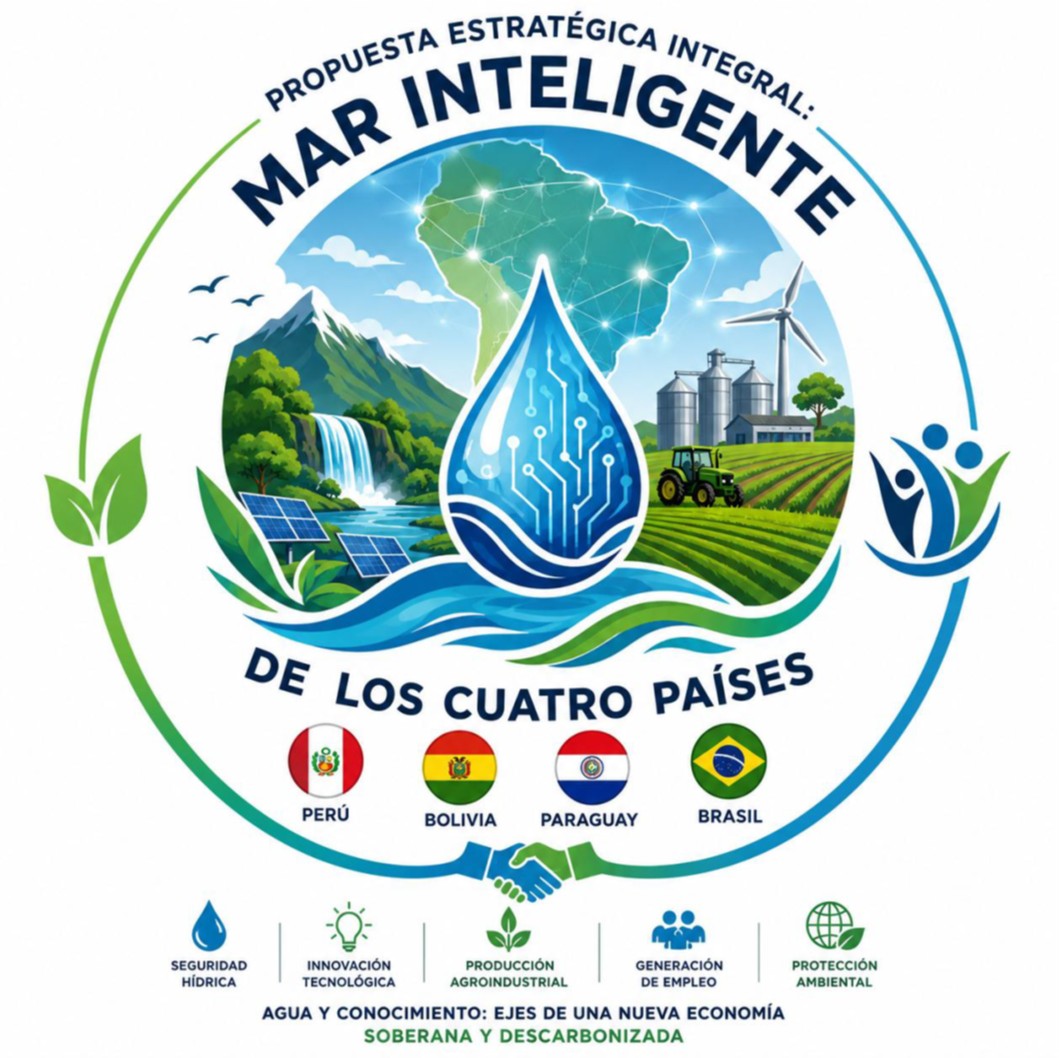
The Represa Trinacional "La Paz"—also known as Project Oro Azul—represents the most ambitious trinational infrastructure initiative in South American history. This $16.575 billion multipurpose project, involving Bolivia, Paraguay, and Brazil, is designed to transform the Rio de la Plata Basin into a global hub for sustainable development, energy security, and continental logistics.
Core Project Parameters
| Parameter | Specification |
|---|---|
| Installed Capacity | 5,000 MW (~35% of Itaipú Binacional) |
| Annual Generation | ~22,000 GWh |
| Total Investment | $16,575,009,850 |
| Dam Height | 90 – 120 meters |
| Asset Life Cycle | 80 – 100 years |
| Project Duration | 10 – 12 years |
| Turbine Technology | Francis and Kaplan (>92% efficiency) |
| Irrigated Surface | 1.05 million hectares |
| Jobs Created | 170,000 (direct and indirect) |
Strategic Value Proposition
1. Energy Integration: Strengthening regional energy security through 5,000 MW of clean, renewable baseload power.
2. Logistical Sovereignty: Overcoming Bolivia's landlocked status ("mediterraneanad") through 365-day navigability of the Paraguay-Parana waterway.
3. Productive Transformation: Irrigating 1.05 million hectares (700,000 new + 350,000 technified) to create a regional "granary."
4. Shared Sovereignty: A trilateral governance model inspired by Itaipú Binacional, establishing a "condominio hídrico" for collective resource management.
5. Industry 4.0 Integration: Digital Twins, SCADA systems, and AI-driven Smart Grids for predictive maintenance and operational excellence.
"Where there is intelligently managed water, there is sustainable development."
"Donde hay agua gestionada con inteligencia, hay desarrollo sostenible."
1. STRATEGIC CONTEXT AND GEOPOLITICAL RATIONALE
1.1 The Hydric Condominium: A New Paradigm
The Represa Trinacional "La Paz" moves beyond the traditional bilateral hydroelectric model to establish a "condominio hídrico" — a shared water domain where three nations collectively manage the resources of the Río de la Plata Basin. This paradigm shift transitions the region from a history of resource competition toward supranational cooperation.
The project is formally identified through three national program designations:
Bolivia: "Programa Represa 149" ($8.704 billion)
Paraguay: "Represa N° 63 Oro Azul" ($2.336 billion)
Brazil: "Represa Trinacional Itaipú/121" ($5.533 billion)
1.2 Resolution of Bolivia's Mediterranean Dilemma
Bolivia's landlocked status has historically imposed prohibitive logistical costs and seasonal vulnerabilities. Project Oro Azul functions as a "hydric bridge" to the Atlantic, effectively extending the coastline into the heart of the continent. By stabilizing the Hidrovía Paraguay-Parana through automated flow control and navigation locks, the project transforms Bolivia from a passive mediterranean state into an active logistics hub.
1.3 Benchmark: The Itaipú Legacy
The project builds upon the lessons of Itaipú Binacional, which demonstrated that transboundary cooperation can transform potential conflict into prosperity through cost and benefit sharing, joint management, and operational integration. With 14,000 MW of installed capacity, Itaipú remains the world's most productive dam. Project Oro Azul, at 5,000 MW, represents approximately 35% of Itaipú's capacity, applying and evolving the binational governance model to a trilateral context.
2. TECHNICAL DEVELOPMENT AND INFRASTRUCTURE
2.1 Engineering Specifications
The dam is designed for an 80-to-100-year lifespan, adhering to ICOLD (International Commission on Large Dams) safety standards and multiple ISO certifications:
| Standard | Application |
|---|---|
| ISO 9001 | Quality management |
| ISO 14001 | Environmental management |
| ISO 55001 | Asset management |
| ISO 31000 | Risk management |
| ISO 45001 | Health and safety |
2.2 Turbine Technology
The powerhouse employs a dual-technology approach:
| Turbine Type | Application | Efficiency |
|---|---|---|
| Francis | High-head, steady baseload power | >92% |
| Kaplan | Variable-flow conditions with adjustable blades | >92% |
This dual configuration ensures revenue stability during low-flow periods while providing robust baseload power during peak cycles.
2.3 Digital Twin and Industry 4.0 Integration
The project incorporates a Digital Twin—a high-fidelity virtual replica of the physical infrastructure—serving as the "Single Source of Truth" for all three nations. Key functions include:
Predictive Maintenance: AI-driven identification of mechanical fatigue before failure
Risk Simulation: Modeling extreme climate events and sedimentation patterns
Data Integrity: Simultaneous sharing of hydraulic simulations preventing any single nation from manipulating flow data
SCADA Integration: Real-time monitoring and control of all technical operations
2.4 Navigation Locks: The "Staircase for Ships"
To guarantee 365-day navigability, the project employs sophisticated navigation locks (esclusas) that overcome the dam's 90-120 meter vertical drop. This allows massive barge convoys to transit without interruption, securing Bolivia's sovereign, reliable fluvial gateway to the Rio de la Plata and the global ocean.
2.5 Multimodal Logistics Integration
The project includes the construction or rehabilitation of 114 bridges and multimodal ports, connecting fluvial, road, and rail transport. A dedicated terrestrial corridor to the Port of Santos in Brazil provides complementary export route redundancy, reducing transport costs and increasing global competitiveness.
3. AGRICULTURAL AND PRODUCTIVE IMPACT
3.1 Irrigation Expansion
The project aims to revolutionize regional food security through a massive irrigation component:
| Category | Surface (Hectares) |
|---|---|
| New Agricultural Areas | 700,000 |
| Improved/Technified Areas | 350,000 |
| Total Irrigated Surface | 1,050,000 |
3.2 The Bioscience Axis (Eje de la Biociencia)
Beyond agriculture, the project anchors the Bioscience Axis - a trinational corridor for innovation, biotechnology research, and technological transfer. This corridor is designed to move the region away from simple raw material extraction toward a sophisticated bioeconomy, linking agricultural production with high-tech biotech research centers.
4. ENVIRONMENTAL STEWARDSHIP
4.1 The PICE Program (Programa Integral de Compensación Ecológica)
The project operates under a mandate of "Impact Net Positive," where restoration efforts exceed the physical footprint of the infrastructure:
| Impact Area | Mitigation Action |
|---|---|
| Land Submersion | 60,000 hectares flooded to create the reservoir |
| Forest Restoration | 90,000 hectares reforested (1.5:1 ratio) |
| Watershed Stability | Management of 210 sub-basins |
| Aquatic Biodiversity | Low-mortality ecological turbines |
| Hydrological Health | 365-day automated flow regulation |
4.2 Fish Protection Technologies
To mitigate impacts on migratory fish species, the project employs:
Ecological Turbines: Francis and Kaplan models with aerodynamic profiles designed to minimize pressure changes and fish mortality
Fish Ladders (Scales): Sophisticated migratory passages allowing native species to overcome the 90-120 meter height of the dam, preserving genetic connectivity and natural repopulation of the river system
4.3 Environmental Certifications
The project targets full compliance with:
ISO 14001: Environmental management systems
Green Bond and Climate Bond Standards: Ensuring eligibility for ESG-restricted capital
Equator Principles: Risk management framework for financial institutions
5. SOCIAL RESPONSIBILITY AND COMMUNITY DEVELOPMENT
5.1 The PRVD Program (Plan de Reasentamiento con Vivienda Digna)
The project addresses the relocation of approximately 3,000 affected families through a comprehensive program providing:
- Dignified housing with full services
- Cultural safeguards for indigenous communities (aligned with ILO Convention 169)
- 84 health centers
- 62 schools
5.2 The 1% Social Fund
A permanent mechanism allocates 1% of gross annual revenue (approximately $15 million/year) to local community development and specialist training. This endowment ensures long-term operation, staffing, and maintenance of regional infrastructure, preventing schools and clinics from becoming "ghost infrastructure" once construction ends.
5.3 Employment Generation
The project generates 170,000 total jobs (direct and indirect), fostering a new generation of specialized technical talent. A dedicated MOOC training platform will provide technical skills to 1.7 million users, preparing the local workforce for the jobs created by the project.
5.4 Social Return on Investment (SROI)
The project Social ROI is estimated at 6:1 to 10:1, reflecting the multiplier effect of linking 5,000 MW of power to 170,000 jobs and 1.05 million hectares of newly productive land.
6. FINANCIAL ANALYSIS
6.1 Capital Structure
The total construction cost is estimated at $16,575,009,850 allocated as follows:
| Country | Program Designation | Investment (USD) |
|---|---|---|
| Bolivia | "Represa 149" | $8,704,800,007 |
| Paraguay | "Represa 63 Oro Azul" | $2,336,284,537 |
| Brazil | "Represa Trinacional Itaipú" | $5,533,925,306 |
| TOTAL | Represa Trinacional "La Paz" | $16,575,009,850 |
6.2 Financial Indicators
| Indicator | Value |
|---|---|
| Internal Rate of Return (IRR) | 8.5% - 10% |
| Annual Projected Revenue | $1.5 billion |
| Payback Period | 12 - 15 years |
| Social ROI | 6:1 - 10:1 |
| Annual Social Fund Allocation | ~$15 million |
6.3 Revenue Streams
The $1.5 billion annual revenue stream is diversified across:
1. Energy Sales: Power purchase agreements (PPAs) with sovereign and industrial off-takers
2. Navigation Tolls: Fees from the stabilized 365-day waterway
3. Irrigation Fees: Services for 1.05 million hectares of agricultural land
6.4 Funding Instruments
| Instrument | Application |
|---|---|
| Green Bonds | ESG-restricted capital |
| Climate Bonds | Low-carbon infrastructure certification |
| Multilateral Financing | World Bank, IDB, CAF, FONPLATA, BNDES |
| Public-Private Partnerships (APP) | Private capital participation |
| Power Purchase Agreements (PPAs) | Revenue security through take-or-pay contracts |
6.5 Credit Enhancement
The project is structured for Green Bond and Climate Bond certification, making it eligible for trillions in ESG-restricted capital. Multilateral participation from the World Bank, IDB, CAF, and BNDES acts as credit enhancement, lowering the risk premium for private institutional lenders through shared oversight and political risk insurance.
7. GOVERNANCE AND INSTITUTIONAL STRUCTURE
7.1 The Trilateral Treaty
The project is codified in a binding International Treaty that establishes "Immunity of Jurisdiction" (Immunidad de Jurisdicción)—a vital geopolitical safeguard protecting the $16.5 billion asset from local judicial interference or shifting political cycles. This legal shield is the primary catalyst for securing international financing.
7.2 The Four-Pillar Governance Structure
| Pillar | Entity | Function |
|---|---|---|
| 1 | CTEH (Consorcio Trinacional de Energía Hidroeléctrica) | Technical and commercial operations; energy dispatch |
| 2 | ATSAS (Autoridad Trinacional de Supervisión Ambiental y Social) | Independent fiscal body auditing environmental and social safeguards |
| 3 | STPC (Sistema de Transparencia y Participación Ciudadana) | Social auditing mechanism for public transparency |
| 4 | Tri-national Council for Water and Energy Integration | Strategic coordination involving ministries and state energy companies (ENDE, ANDE, Eletrobras) |
7.3 Modeled on Itaipú
The governance structure draws from the Itaipú Binacional model, which has demonstrated that separating operation from oversight is a strategic requirement for Compliance and ESG standards. The deliberate separation of the CTEH (operator) and the ATSAS (supervisor) mitigates reputational risks and maintains eligibility for low-interest international capital.
8. IMPLEMENTATION ROADMAP
8.1 Phased Execution Strategy
| Phase | Duration | Activities | Key Deliverables |
|---|---|---|---|
| Phase 1 | Years 1-3 | Pre-feasibility, hydrological studies, diplomatic agreements | Treaty ratification; feasibility studies |
| Phase 2 | Years 3-5 | Environmental licensing, treaty ratification, financial structuring | ISO 14001 compliance; bond issuance |
| Phase 3 | Years 5-10 | Staged construction; first turbine operation | First turbine online (Year 5/6); early cash flow |
8.2 Critical Milestones
Year 1-2: Trilateral treaty signed and ratified
Year 3: Environmental licensing completed; financial closing
Year 5: First turbine operational (early cash flow)
Year 8: 50% of turbines operational
Year 10: All turbines operational
Year 12: Full commercial operation; project completion
8.3 Engineering Documentation
The project includes a comprehensive 40-volume technical dossier (Issued For Construction - IFC), comprising 30,000 to 100,000 blueprints and millions of design data points, including specialized volumes on:
Digital Twin and AI (Vol. XXXV): Predictive maintenance and climate risk simulation
Tri-national Governance (Vol. XXXVIII): Legal and operative framework
Multimodal Logistics (Vols. XXI-XXIII): Ports, locks, and rail-intermodal connectivity
9. RISK MANAGEMENT MATRIX
| Risk Category | Identified Risk | Probability | Impact | Mitigation Strategy |
|---|---|---|---|---|
| Environmental | ~60,000 ha flood area | High | High | PICE Program: 90,000 ha reforestation (1.5:1 ratio); 210 sub-basin management |
| Social | ~3,000 families | High | High | PRVD Program: Dignified housing; 84 health centers; 62 schools; cultural safeguards |
| Ecological | Migratory fish impact | High | Medium | Low-mortality turbines; automated fish ladders; ecological monitoring |
| Operational | Sedimentation/Safety | Medium | High | Digital Twin predictive modeling; ICOLD adherence |
| Institutional | Political Volatility | Medium | High | Immunity of Jurisdiction via International Treaty |
| Financial | Revenue fluctuation | Medium | Medium | Diversified revenue streams; PPAs; multilateral credit enhancement |
| Hydrological | Extreme drought or flood events | Medium | High | SCADA-controlled automated flow regulation; climate risk simulation |
| Technical | Technology obsolescence | Low | Medium | Industry 4.0 architecture; modular design; Digital Twin updates |
10. KEY PERFORMANCE INDICATORS (KPIs)
| Indicator | Target | Measurement |
|---|---|---|
| Installed Capacity | 5,000 MW | Turbine commissioning reports |
| Annual Generation | ~22,000 GWh | Monthly production data |
| Project Completion | 12 years | Phase milestone achievement |
| Budget Adherence | ±10% variance | Financial audits |
| Irrigated Surface | 1.05 million hectares | Land registration and usage data |
| Jobs Created | 170,000 | Employment registry |
| Reforestation | 90,000 hectares | Satellite monitoring; ground verification |
| Social Fund Allocation | $15 million/year | Financial reports |
| ESG Compliance | Full certification | ISO 14001; Green Bond certification |
| Navigability | 365 days/year | Waterway traffic records |
11. INTERNATIONAL BENCHMARK
| Project | Countries | Capacity | Investment | Key Lesson |
|---|---|---|---|---|
| Itaipú Binacional | Brazil-Paraguay | 14,000 MW | ~$20 billion | Cost and benefit sharing; joint management |
| Yacyretá | Argentina-Paraguay | 3,100 MW | ~$11 billion | Navigation improvement; irrigation; fishery development |
| Three Gorges Dam | China | 22,500 MW | ~$37 billion | World's largest; sediment management challenges |
| La Paz Trinacional | Bolivia-Paraguay-Brazil | 5,000 MW | $16.575 billion | Trilateral governance; Digital integration; 1.5:1 reforestation |
Best Practices Applicable:
1. Transboundary Cooperation: Itaipú's success in transforming potential conflict into cooperation through cost and benefit sharing
2. Independent Oversight: Separation of operational and supervisory functions (CTEH vs. ATSAS)
3. Digital Transparency: Digital Twin as "Single Source of Truth" preventing data manipulation
4. Net Positive Environmental Impact: 1.5:1 reforestation ratio exceeding physical footprint
5. Social Endowment: 1% gross revenue Social Fund ensuring long-term community benefits
6. Legal Immunity: Treaty-protected jurisdiction shielding investment from political cycles
12. STRATEGIC CONCLUSIONS
1. Geopolitical Transformation: Project Oro Azul resolves Bolivia's landlocked status through a sovereign, 365-day navigable corridor to the Atlantic, transforming the nation from a passive mediterranean state into an active logistics hub.
2. Energy Sovereignty: With 5,000 MW of clean, renewable baseload power (~35% of Itaipú's capacity), the project strengthens regional energy security and supports cross-border industrial integration.
3. Economic Multiplier: The $16.575 billion investment generates 170,000 jobs, irrigates 1.05 million hectares, and produces $1.5 billion in annual revenue, with a Social ROI of 6:1 to 10:1.
4. Environmental Leadership: The 1.5:1 reforestation ratio (90,000 hectares restored for 60,000 hectares flooded), low-mortality turbines, and fish ladders demonstrate a commitment to "Net Positive" environmental impact.
5. Institutional Innovation: The trilateral governance model—inspired by Itaipú but evolved for three nations—establishes a new paradigm for shared sovereignty and transboundary resource management.
6. Industry 4.0 Excellence: Digital Twins, SCADA systems, and AI-driven predictive maintenance ensure 80–100 year asset life and operational transparency across three nations.
"The water that unites three nations is the energy that illuminates the future."
13. EXECUTIVE RECOMMENDATIONS
1. Accelerate Treaty Ratification: Prioritize the formal signing and ratification of the Trilateral Treaty to establish the legal framework and Immunity of Jurisdiction.
2. Secure Multilateral Financing: Engage World Bank, IDB, CAF, and BNDES for credit enhancement and political risk insurance.
3. Issue Green Bonds: Structure the project for Green Bond and Climate Bond certification to access ESG-restricted capital.
4. Deploy Digital Twin Early: Implement the Digital Twin system during the design phase to establish the "Single Source of Truth" and build trust among the three nations.
5. Establish the ATSAS: Formalize the independent environmental and social supervision authority before construction begins.
6. Launch the PICE Program: Initiate the 90,000-hectare reforestation program in parallel with construction to demonstrate environmental commitment.
7. Activate the Social Fund: Establish the 1% gross revenue Social Fund mechanism to ensure long-term community benefits.
8. Develop Human Capital: Launch the MOOC training platform for 1.7 million users to prepare the local workforce for the 170,000 jobs created.
14. IMPACT STATEMENTS
"This project represents a historic opportunity to transform the economic development of South America through shared sovereignty, renewable energy, and continental integration."
"Este proyecto representa una oportunidad histórica para transformar el desarrollo económico de Sudamérica mediante la soberanía compartida, la energía renovable y la integración continental."
"Innovation is the engine that converts water resources into sustainable prosperity for three nations."
"La innovación es el motor que convierte los recursos hídricos en prosperidad sostenible para tres naciones."
"Strategic investment today guarantees the competitiveness of tomorrow and the energy sovereignty of future generations."
"La inversión estratégica de hoy garantiza la competitividad del mañana y la soberanía energética de las futuras generaciones."
"Sustainable development is built through planning, innovation, and leadership—the three pillars upon which the Oro Azul project stands."
"El desarrollo sostenible se construye mediante planificación, innovación y liderazgo—los tres pilares sobre los que se sostiene el proyecto Oro Azul."
15. GLOSSARY OF KEY TERMS
| Term | Definition |
|---|---|
| ATSAS | Autoridad Trinacional de Supervisión Ambiental y Social; independent environmental and social oversight body |
| Condominio Hidrico | Shared water domain where multiple nations collectively manage hydrological resources |
| CTEH | Consorcio Trinacional de Energía Hidroeléctrica; technical and commercial operator |
| Digital Twin | Virtual, real-time replica of physical infrastructure for predictive maintenance and risk simulation |
| Eje de la Biociencia | Bioscience Axis; trinational corridor for biotechnology research and innovation |
| Esclusas | Navigation locks allowing vessels to bypass dam height differences |
| Francis Turbine | High-efficiency turbine for medium-to-high head applications |
| ICOLD | International Commission on Large Dams; sets global dam safety standards |
| Immunity of Jurisdiction | Legal protection shielding the project from local judicial interference |
| Kaplan Turbine | Adjustable-blade turbine for variable-flow conditions |
| PICE | Programa Integral de Compensación Ecológica; integrated ecological compensation program |
| PRVD | Plan de Reasentamiento con Vivienda Digna; dignified housing resettlement plan |
| SCADA | Supervisory Control and Data Acquisition; real-time monitoring and control system |
| Smart Grid | Intelligent electrical grid using digital technology for efficient energy distribution |
| SROI | Social Return on Investment; metric quantifying broader societal benefits relative to cost |
Represa Trinacional "La Paz" (Oro Azul): Strategic Integration Briefing
The Represa Trinacional "La Paz" (also identified as the Oro Azul program) is a monumental tri-national infrastructure initiative between Bolivia, Paraguay, and Brazil. Designed as a multipurpose project, it aims to transform the River Plate Basin into a global hub for sustainable development. With a projected installed capacity of 5,000 MW and an annual generation of 22,000 GWh, the project represents approximately 35% of the power of Itaipú Binacional.
The project's strategic importance extends beyond power generation, serving as a catalyst for Bolivian sovereignty by providing year-round navigable access to the Atlantic Ocean via the Paraguay-Parana waterway and terrestrial corridors to the Port of Santos. Key financial indicators include a total investment of USD 16.575 billion, an internal rate of return (TIR) of 8.5% - 10%, and the projected creation of 170,000 jobs. Implementation is structured over a 10-to-12-year timeline, utilizing Industry 4.0 technologies such as Digital Twins and SCADA systems to ensure operational excellence and environmental resilience.
1. Strategic Vision and Objectives
The project conceptualizes water as the primary engine for continental integration, focusing on three foundational axes:
Energy Integration: Strengthening regional energy security by generating clean, renewable energy for domestic consumption and export.
Logistical Sovereignty: Overcoming Bolivia's landlocked status ("mediterraneaned") through the improvement of the Paraguay-Parana system, ensuring 365-day navigability.
Productive and Scientific Development: Modernizing the agricultural sector through massive irrigation and establishing the "Bioscience Axis"—a tri-national corridor for innovation and biotechnology research.
2. Technical Infrastructure and Industrial Capacity
The dam is designed for a lifespan of 80 to 100 years, adhering to ICOLD (International Commission on Large Dams) safety standards and multiple ISO certifications (9001, 14001, 55001, 31000, and 45001).
2.1 Technical Specifications
| Component | Description |
|---|---|
| Installed Capacity | 5,000 MW |
| Annual Generation | ~22,000 GWh |
| Dam Height | 90 – 120 meters |
| Turbine Technology | High-efficiency Francis and Kaplan turbines (>92% efficiency) |
| Digital Innovation | SCADA systems, AI-driven Smart Grids, and Digital Twins for predictive modeling |
2.2 Agricultural and Productive Impact
The project aims to revolutionize regional food security through a massive irrigation component:
New Agricultural Areas: 700,000 hectares.
Improved/Technified Areas: 350,000 hectares.
Total Irrigated Surface: 1.05 million hectares.
3. Logistical and Geopolitical Transformation
A primary strategic goal is the structural reconfiguration of South American trade routes, particularly for Bolivia.
Access to the Atlantic: The project utilizes navigation locks to overcome the dam's elevation change, ensuring permanent transit for barges and vessels in the Paraguay-Parana waterway.
Intermodal Connectivity: Integration of fluvial, road, and rail transport. The plan includes the construction/rehabilitation of 114 bridges and multi-modal ports.
Port of Santos Connection: Dedicated terrestrial corridors toward the Port of Santos in Brazil provide a complementary export route, reducing transport costs and increasing global competitiveness.
4. Economic and Financial Framework
4.1 Investment Breakdown by Country
| Country | Program Designation | Investment (USD) |
|---|---|---|
| Bolivia | "Represa 149" | $8,704,800,007 |
| Paraguay | "Represa 63 Oro Azul" | $2,336,284,537 |
| Brazil | "Represa Trinacional Itaipú" | $5,533,925,306 |
| TOTAL | Represa Trinacional "La Paz" | $16,575,009,850 |
4.2 Financial Indicators
Estimated Annual Income: USD 1.5 billion (from energy sales, navigation tolls, and irrigation services).
Internal Rate of Return (TIR): 8.5% - 10%.
Payback Period: 12 - 15 years.
Social ROI: Estimated at 6:1 to 10:1.
Funding Instruments: Public-Private Partnerships (APP), Green Bonds, and multilateral financing (BID, BM, CAF, FONPLATA, BNDES).
5. Socio-Environmental Management and Mitigations
The project implements an "Impact Net Positive" strategy, acknowledging the flooding of 60,000 hectares and the resettlement of approximately 3,000 families.
PICE (Integral Ecological Compensation Program): Plans the reforestation of 90,000 hectares, establishing a 1.5:1 compensation ratio.
PRVD (Dignified Housing Resettlement Plan): Ensures housing with full services, cultural safeguards for indigenous communities, and the construction of 84 health centers and 62 schools.
Ichthyofauna Protection: Use of ecological "low-mortality" turbines and fish scales (ladders) to allow for natural migration and repopulation of native species.
Social Fund: Allocation of 1% of gross annual income (~USD 15 million/year) for local community development and specialist training.
6. Governance and Institutional Structure
Inspired by the Itaipú Binacional model, the project's governance is based on a legally binding International Treaty and four institutional pillars:
1. CTEH (Tri-national Hydroelectric Energy Consortium): Responsible for technical and commercial operations.
2. ATSAS (Tri-national Environmental and Social Supervision Authority): An independent body for fiscalizing environmental and social safeguards.
3. STPC (Transparency and Citizen Participation System): A mechanism for social auditing and public access to information.
4. Tri-national Council for Water and Energy Integration: The overarching strategic coordination entity involving ministries and state energy companies (ENDE, ANDE, Eletrobras).
7. Implementation Roadmap
The project is divided into four distinct phases over a 10-to-12-year duration:
Phase 1 (Years 1-3): Pre-feasibility, hydrological studies, and diplomatic agreements.
Phase 2 (Years 3-5): Environmental licensing, treaty ratification, and financial structuring.
Phase 3 (Years 5-10): Staged construction; the first turbine is expected to be operational by Year 5 or 6.
Phase 4 (Years 10-12): Progressive commissioning and full commercial operation.
8. Summary of Engineering Documentation (IFC)
The project includes a comprehensive 40-volume technical dossier (Issued For Construction - IFC), comprising 30,000 to 100,000 blueprints and millions of design data points. This includes specialized volumes on:
Digital Twin and AI (Vol. XXXV): For predictive maintenance and climate risk simulation.
Tri-national Governance (Vol. XXXVIII): Detailing the legal and operative framework.
Multimodal Logistics (Vol. XXI-XXIII): Covering ports, locks, and rail-intermodal connectivity.
I. Short-Answer Quiz
Instructions: Answer the following questions based on the text in 2-3 sentences.
1. What are the primary strategic objectives of the "Oro Azul" project beyond energy generation?
2. How does the project's energy capacity compare to that of Itaipú Binacional?
3. In what ways does this project address Bolivia's historical "mediterraneaned" (landlocked status)?
4. What specific role do "Digital Twins" play in the management and safety of the dam?
5. Describe the agricultural impact of the project in terms of irrigation and land use.
6. What is the "Programa Integral de Compensación Ecológica" (PICE) and what is its specific restoration target?
7. How is the relocation of affected families managed under the project's social framework?
8. What is the proposed financial model for the project and what happens to the infrastructure after the investment is recovered?
9. Distinguish between the roles of the CTEH and the ATSAS within the project's governance structure.
10. What technologies are employed to ensure the protection of migratory fish species?
II. Answer Key
1. Primary Strategic Objectives: Beyond energy, the project aims to establish sovereign logistics for Bolivia, modernize regional agroindustry through massive irrigation, and create the "Eje de la Biociencia" for technological innovation. It treats water as a motor for continental integration and a node for sustainable development.
2. Energy Capacity Comparison: The project has a projected installed capacity of 5,000 MW and an annual generation of approximately 22,000 GWh. This capacity represents roughly 35% of the power of Itaipú Binacional, which has an installed capacity of 14,000 MW.
3. Bolivia's Landlocked Status: The project provides Bolivia with sovereign access to the Atlantic Ocean by ensuring year-round navigability of the Paraguay-Paraná waterway via navigation locks. Additionally, it establishes terrestrial corridors and multimodal ports connecting to the Port of Santos in Brazil.
4. Role of Digital Twins: Digital Twins are virtual replicas of the physical infrastructure used to simulate hydraulic behavior, predict sedimentation, and model extreme climate risks. They function as a "Single Source of Truth" to prevent information manipulation and optimize predictive maintenance.
5. Agricultural Impact: The project aims to irrigate 1.05 million hectares in total, consisting of 700,000 hectares of new agricultural land and 350,000 hectares improved through technification. This expansion is designed to bolster regional food security and support high-value agroindustrial chains.
6. PICE and Restoration Targets: PICE is the Integrated Ecological Compensation Program designed to achieve a net positive environmental impact. It mandates the reforestation of 90,000 hectares to compensate for the 60,000 hectares inundated by the dam, maintaining a 1.5:1 compensation ratio.
7. Social Management of Relocation: Relocation is handled via the Plan de Reasentamiento con Vivienda Digna (PRVD), affecting approximately 3,000 families. The plan provides dignified housing, health centers, schools, and cultural safeguards for indigenous communities in alignment with international standards like the ILO Convention 169.
8. Financial and Ownership Model: The project utilizes a temporary concession model supported by long-term Power Purchase Agreements (PPAs) and instruments like Green Bonds. Following the 12-15 year recovery period, the infrastructure is transferred to the joint ownership of the three participating states.
9. CTEH vs. ATSAS: The CTEH (Trinational Hydroelectric Energy Consortium) is responsible for the technical and commercial operation of the plant, including energy dispatch. The ATSAS (Trinational Environmental and Social Supervision Authority) is an independent fiscal entity that audits compliance with environmental and social safeguards.
10. Fish Protection Technologies: To mitigate impacts on icticola (fish) life, the project uses eco-friendly turbines (Francis and Kaplan) designed for low mortality. It also includes "fish ladders" or scales that allow migratory species to navigate the height difference of the dam (90-120 meters).
Part III: Suggested Essay Questions
Geopolitics of Water: Analyze how the "Oro Azul" project transforms the concept of national sovereignty into "Shared Sovereignty" (Soberanía Compartida). Discuss the implications of this shift for regional stability and economic competitiveness in the Cuenca del Plata.
The Fourth Industrial Revolution in Infrastructure: Discuss the integration of Industry 4.0 technologies—such as SCADA, AI, Smart Grids, and Digital Twins—within the project. How do these tools shift the paradigm of dam management from reactive maintenance to predictive intelligence?
Balancing Development and Ecology: Evaluate the project's strategy for environmental sustainability. Focus on whether the 1.5:1 reforestation ratio and the use of eco-turbines are sufficient to offset the ecological costs of a 60,000-hectare inundation.
Economic Impact and Social ROI: Examine the projected financial indicators (TIR of 8.5-10%) alongside the "Social ROI" (estimated at 6:1 to 10:1). How does the 1% Gross Income Social Fund contribute to the long-term viability of the project?
Logistical Redundancy and Continental Integration: Explain the strategic importance of the multimodal logistics plan. Compare the benefits of the Paraguay-Paraná waterway access to the Atlantic with the terrestrial corridor to the Port of Santos.
Part IV: Comprehensive Glossary
| Term | Definition |
|---|---|
| ATSAS | Autoridad Trinacional de Supervision Ambiental y Social; an independent body tasked with auditing and fiscalizing environmental and social safeguard compliance. |
| Bonos Verdes | Green Bonds; debt instruments used to finance projects with verified environmental benefits, such as renewable energy. |
| CTEH | Consorcio Trinacional de Energía Hidroeléctrica; the entity responsible for the technical, commercial, and operational management of the power plant. |
| Digital Twin | A virtual, dynamic model of the dam that uses real-time sensor data to simulate performance, predict risks, and manage assets. |
| Eje de la Biociencia | A trinational corridor for innovation, biotechnology research, and technological transfer linked to the project's water and energy resources. |
| Esclusas | Navigation Locks; engineering works that allow vessels to bypass the dam's height difference, ensuring continuous river traffic. |
| Estiaje | A period of extreme drought or low water levels; the project uses automated flow control to maintain navigability during these times. |
| Francis & Kaplan | High-efficiency turbine types used in the project; Kaplan turbines feature adjustable blades to handle fluctuating flow rates. |
| Hidrovía Paraguay-Paraná | A vital regional fluvial corridor connecting Bolivia, Paraguay, and Brazil to the Atlantic Ocean via the Río de la Plata. |
| ICOLD | International Commission on Large Dams; the global organization that sets standards for the structural safety and design of large dams. |
| Ictícola | Relating to fish; used in the context of protecting native fish species through ecological turbines and migration scales. |
| ISO 14001 | The international standard for environmental management systems used to monitor and certify the project's ecological impact. |
| Logística Intermodal | A transport system integrating different modes (river, road, rail, and port) to move cargo efficiently across borders. |
| PICE | Programa Integral de Compensación Ecológica; a strategy for massive reforestation and basin stabilization to achieve an ecological balance. |
| PRVD | Plan de Reasentamiento con Vivienda Digna; the social program for the relocation and compensation of families affected by the reservoir. |
| ROI Social | Social Return on Investment; a metric used to quantify the broader societal benefits (jobs, health, education) relative to the project's cost. |
| SCADA | Supervisory Control and Data Acquisition; a digital system for real-time monitoring and control of the dam's technical operations. |
| Smart Grid | An intelligent electrical grid that uses digital technology to manage energy distribution efficiently across the trinational network. |
| TIR | Internal Rate of Return; a financial indicator of the project's profitability, projected between 8.5% and 10%. |
The "Oro Azul" Breakthrough: How a Hidden Triple-Border Project Could Redefine South America
For over a century, Bolivia's economic destiny has been written by its geography. This "mediterraneanidad"—a persistent landlocked status—has acted as a structural ceiling, forcing the nation to navigate a labyrinth of dependencies to reach global markets. But in the humid heart of the Southern Cone, where the borders of Bolivia, Paraguay, and Brazil converge, a massive technological awakening is underway.
The Represa Trinacional La Paz, colloquially known as "Oro Azul" (Blue Gold), is far more than a civil engineering feat. It is a $16.57 billion hydro-energetic initiative designed to function as a "bridge of brotherhood." By merging cutting-edge Industry 4.0 technology with a radical new model of shared sovereignty, this transnational giant is poised to transform South America's landlocked heartbeat into its most vital intermodal node.
1. The End of Geographic Isolation: A Staircase for Ships
The most profound geopolitical pivot of Oro Azul is its ability to effectively slide the Atlantic coastline 1,500 kilometers inland. Historically, the Hidrovia Paraguay-Parana has been a seasonal gamble, with fluctuating water levels often throttling trade for months at a time.
Oro Azul solves this through a masterstroke of hydraulic engineering: a "staircase for ships." By installing sophisticated navigation locks (esclusas) and automated flow control, the project overcomes the 90-120 meter vertical drop of the dam. This allows massive barge convoys to transit without interruption, guaranteeing 365-day-a-year navigability. For the first time in its modern history, Bolivia secures a sovereign, reliable fluvial gateway to the Rio de la Plata and the global ocean.
2. The Digital Twin: A Diplomatic "Single Source of Truth"
In a region where data can be politicized, Oro Azul introduces a "Single Source of Truth" through Gemelos Digitales (Digital Twins). This isn't just a virtual model for maintenance; it is a diplomatic safeguard.
By utilizing SCADA (Supervisory Control and Data Acquisition) systems and Artificial Intelligence, the three nations share a high-fidelity, real-time digital replica of the dam's entire ecosystem. This ensures total transparency:
Data Integrity: Simulations of hydraulic behavior and sedimentation are shared simultaneously, preventing any single nation from manipulating flow data.
Predictive Resilience: The twin predicts climate risks and extreme weather events, allowing for optimized floodgate responses before a crisis hits.
Longevity: This Industry 4.0 approach allows for predictive maintenance that extends the infrastructure's life expectancy to a century, ensuring the $16.57 billion investment remains productive for generations.
3. A Powerhouse of Global Proportions
To grasp the scale of this hydro-energetic initiative, one must look at the energy density it provides. With an installed capacity of 5,000 MW, Oro Azul is a regional titan, representing roughly 35% of the capacity of the legendary Itaipú Binacional. This output is critical for stabilizing the Smart Grids of the Southern Cone, providing the clean "baseload" power necessary for large-scale industrialization.
By the Numbers: The Oro Azul Energy Profile
| Category | Specification | Technical Nuance |
|---|---|---|
| Installed Capacity | 5,000 MW | ~35% of Itaipú Binacional |
| Annual Generation | ~22,000 GWh | Clean, renewable baseload |
| Turbine Efficiency | >92% | Francis & Kaplan high-versatility models |
4. The 1.5:1 Rule: Radical Environmental Responsibility
Large-scale dams are often seen as ecological trade-offs. Oro Azul attempts to flip this narrative through the PICE (Integrated Ecological Compensation Program). The project operates on an aggressive 1.5:1 ratio for environmental restoration.
While the reservoir will submerge 60,000 hectares of land, the treaty mandates the reforestation of 90,000 hectares. This strategy targets a "Net Positive Impact," stabilizing 210 sub-basins to ensure the long-term health of the Cuenca del Plata. To protect the river's biological heritage, the dam utilizes "ecological turbines"—Francis and Kaplan models designed with aerodynamics that minimize pressure changes—and fish ladders to ensure safe passage for migratory species across the dam's massive height.
5. The Bioscience Axis: Converting Dust into Bread
The project's utility extends far beyond the electrical grid, anchoring what strategists call the "Eje de la Biociencia" (Bioscience Axis). This corridor is designed to move the region away from the simple extraction of raw materials toward a sophisticated bioeconomy.
By providing irrigation for 1.05 million hectares (700,000 new and 350,000 improved hectares), the project secures regional food sovereignty. This "converting of dust into bread" is projected to create 170,000 jobs, linking agricultural production with high-tech biotech research centers. It is a vision of an agro-industrial corridor where water management and innovation intersect to create a global breadbasket.
6. The Legal Shield: A Model of Shared Sovereignty
Executing a project of this magnitude requires more than just concrete; it requires a bulletproof legal architecture. The $16,575,009,850 construction cost is protected by a Trinational Treaty that establishes "immunity of jurisdiction."
This legal shield protects the investment from the "pendular" political cycles of individual nations, ensuring that the project remains bankable and stable regardless of local shifts in government. Each nation identifies the project through its own strategic lens—Bolivia (Program 149), Paraguay (Represa 63), and Brazil (Represa 121)—but the governance is unified under three pillars:
- CTEH (Consorcio Trinacional de Energia Hidroeléctrica): The technical and commercial heart of the operation.
- ATSAS (Autoridad Trinacional de Supervision Ambiental y Social): An independent fiscal body ensuring "compliance" with international ESG standards.
- STPC (Sistema de Transparencia y Participación Ciudadana): A mechanism for real-time social auditing and public transparency.
Conclusion: A New Era for the Southern Cone
The Oro Azul project is the definitive signal that South America is ready to move past a "diplomacy of paper" toward an "integration of facts." By solving the riddle of Bolivia's geography and harnessing the power of the Cuenca del Plata with Industry 4.0 precision, the three participating nations are doing more than building a dam; they are constructing a template for continental autonomy.
Is the Oro Azul the definitive model for South America to finally bridge the gap between its natural wealth and its industrial potential? If the "Single Source of Truth" provided by its digital twin is any indication, the future of the continent is no longer just a vision—it is an engineering reality.
"Where there is intelligently managed water, there is sustainable development."
Investment Prospectus: Represa Trinacional "La Paz" (Project Oro Azul)
1. Strategic Investment Thesis and Regional Economic Integration
The Represa Trinacional "La Paz" (Project Oro Azul) represents a premier, multi-billion-dollar infrastructure opportunity designed to redefine the economic geography of the Cuenca del Plata. This "Condominio Hidrico" (Hydric Condominium) is not merely a utility play; it is a defensive, high-yield economic asset that transforms Bolivia's landlocked status into a strategic logistical nexus for South America. By creating a tripartite sovereign framework between Bolivia, Paraguay, and Brazil, the project provides credit enhancement through regional cooperation and multilateral alignment.
A critical component of this thesis is the restoration of Bolivia's access to the Atlantic. Through advanced automated flow regulation, the project guarantees 365-day navigability of the Paraguay-Parana waterway. This eliminates the seasonal volatility currently strangling regional trade, fundamentally altering the competitive landscape by providing a sovereign, year-round corridor to global markets. This strategic integration establishes the project as a critical geopolitical catalyst, shifting the region from a traditional extraction-based economy to a high-efficiency logistics and energy hub.
2. Technical Asset Profile and Industrial Capacity
Project Oro Azul is engineered as a tier-one global energy asset, with a 5,000 MW installed capacity positioning it among the most efficient hydroelectric plants worldwide. Beyond energy generation, the asset serves as the foundation for the "Eje de la Biociencia" (Bioscience Axis)—a trinacional innovation corridor designed to power high-tech industrial hubs and biotechnology research centers, ensuring that the project's output fuels regional industrialization rather than just raw export.
Technical Specifications Summary
| Component | Specification |
|---|---|
| Installed Capacity | 5,000 MW (approx. 35% of Itaipú Binacional) |
| Annual Generation | ~22,000 GWh |
| Asset Life Cycle | 80 – 100 Years |
| Turbine Efficiency | >92% |
| Technological Framework | SCADA, AI-Driven Smart Grids, Digital Twin |
| Operational Standards | ICOLD (International Commission on Large Dams) |
The project utilizes a dual-technology approach, deploying both Francis and Kaplan turbines. The inclusion of Kaplan turbines, with their adjustable blades, is a strategic choice to ensure revenue stability during low-flow periods, while Francis turbines provide robust baseload power during peak cycles. To capture ESG-restricted capital, the project employs low-mortality ecological turbines and fish ladders, minimizing environmental impact.
Furthermore, the implementation of a Digital Twin—aligned with ISO 55001 (Asset Management) and ISO 31000 (Risk Management)—serves as the primary mechanism for protecting the long-term Internal Rate of Return (IRR). By utilizing predictive AI to model sedimentation and structural integrity, the Digital Twin ensures the 80-100 year asset life, providing a "single source of truth" for institutional investors and technical auditors.
3. Capital Structure and Investment Requirements
The capital allocation for Project Oro Azul is structured to ensure transparency and institutional ring-fencing across the participating nations. The total construction cost is meticulously detailed to include not only the core energy asset but also the multimodal infrastructure required to realize the project's strategic vision.
Breakdown of Capital Allocation (USD):
Bolivia ("Represa 149"): $8,704,800,007
Brazil ("Represa Trinacional Itaipú"): $5,533,925,306
Paraguay ("Represa 63 Oro Azul"): $2,336,284,537
It is vital to distinguish between the Core Program Investment of $12 billion and the Total Construction Cost of $16.575 billion. The delta represents the extensive auxiliary infrastructure—including 114 bridges, multimodal fluvial ports, and specialized navigation locks—necessary to integrate the regional logistics network. This comprehensive scope ensures that the project delivers more than just power; it delivers a fully operational, integrated economic corridor.
4. Financial Performance and Return Projections
Project Oro Azul offers a compelling financial profile, characterized by long-duration revenue predictability and high-impact social returns, meeting the rigorous mandates of pension funds, ESG portfolios, and multilateral development banks.
Financial Highlights:
Internal Rate of Return (IRR): 8.5% - 10%
Annual Projected Revenue: $1.5 billion
Payback Period: 12 - 15 years
Social ROI: 6:1 to 10:1
The $1.5 billion annual revenue stream is diversified across energy sales, navigation tolls from the stabilized waterway, and irrigation fees for 1.05 million hectares of agricultural land. This multi-revenue model provides significant protection against sector-specific shocks. Additionally, the project establishes a "Fondo Social" (Social Fund), allocating 1% of gross annual income (~$15 million/year) toward local development. This fund, combined with the construction of 84 health centers and 62 schools, secures the "Social License to Operate," a critical metric for de-risking investments under the Equator Principles.
5. Funding Instruments and Revenue Security (PPA & Green Bonds)
To minimize the weighted average cost of capital (WACC), Project Oro Azul employs a sophisticated "Green Finance" strategy that prioritizes off-take certainty and credit enhancement.
Cash Flow Certainty via PPAs: The primary security for debt service is established through long-term Power Purchase Agreements (PPAs) with sovereign and industrial off-takers. These "take-or-pay" contracts provide the predictable cash flows necessary to support highly leveraged institutional debt.
Green and Climate Bond Eligibility: The project is structured for certification under Green Bond and Climate Bond standards. Adherence to ISO 14001 and the use of low-mortality turbine technology make the asset eligible for trillions in ESG-restricted capital.
Multilateral Participation: The involvement of the World Bank, IDB, CAF, and BNDES acts as a credit enhancement, lowering the risk premium for private institutional lenders through shared oversight and political risk insurance.
6. Governance Model and International Framework
The project's governance is modeled on the "Itaipú Binacional" success story, enhanced for a tripartite context. The legal bedrock of the investment is an International Treaty, which provides "Immunity of Jurisdiction" (Immunidad de Jurisdicción). This institutional shield is paramount for project finance in the region, protecting the asset and its revenue streams from local judicial interference, political volatility, and domestic policy shifts.
The Four-Pillar Governance Structure:
1. International Treaty: The binding legal instrument establishing immunity of jurisdiction and sovereign guarantees.
2. Consorcio Trinacional de Energia Hidroeléctrica (CTEH): The autarkic operational entity responsible for the plant's technical and commercial management.
3. Autoridad Trinacional de Supervisión Ambiental y Social (ATSAS): An independent fiscalizing body ensuring compliance with ESG mandates and the Equator Principles.
4. Sistema de Transparencia y Participación Ciudadana (STPC): A digital-first transparency mechanism for social auditing and financial reporting.
7. Implementation Roadmap and Risk Mitigation
Project Oro Azul follows a phased execution strategy designed to accelerate "Time-to-Revenue" and mitigate front-end development risks.
Implementation Timeline:
Phase 1 (Years 1-3): Hydrological feasibility, diplomatic treaty ratification, and preconstruction engineering.
Phase 2 (Years 3-5): Environmental licensing (ISO 14001) and final financial structuring/bond issuance.
Phase 3 (Years 5-10): Staged construction; First Turbine Operation begins in Year 5/6, initiating early cash flow to service debt.
Phase 4 (Years 10-12): Commissioning of all units and transition to full commercial operation.
Risk & Mitigation Framework:
The project incorporates human capital development through a MOOC Platform designed to train 1.7 million users in technical management and sustainability, ensuring a specialized local workforce and long-term operational resilience.
By synthesizing world-class engineering with a robust, treaty-protected governance framework, Project Oro Azul stands as the definitive South American energy benchmark—a de-risked, high-impact investment for the 21st century.
Engineering the Future: Inside the Oro Azul Trinational Dam
1. The Vision of a "Living Machine"
As a systems architect, I invite you to view the Represa Trinacional "La Paz"—widely known as Oro Azul—not merely as a static barrier of concrete, but as a "Living Machine." This is a complex, intelligent ecosystem where mechanical precision, digital oversight, and geopolitical strategy converge. At its core, Oro Azul is a Condominio Hidrico (Water Condominium), a unique three-nation partnership between Bolivia, Paraguay, and Brazil designed to transform the Cuenca del Plata into a multi-purpose engine for regional integration.
The scale of this commitment is reflected in its investment architecture, totaling approximately $16.57 billion in construction costs:
Bolivia ("Programa 149"): ~$8.7 billion
Paraguay ("Represa 63"): ~$2.3 billion
Brazil ("Represa 121"): ~$5.5 billion
2. Measuring Might: Understanding MW vs. GWh
In high-level systems engineering, we distinguish between a plant's instantaneous capacity and its cumulative productivity. This is the distinction between Power and Energy. For a "Smart Grid" to maintain stability, it requires both: Power ensures the grid can meet peak demand without failure, while Energy provides the measurable work required for long-term industrialization.
| Unit Name | Technical Definition | The "Car & Trip" Analogy | The Oro Azul Value |
|---|---|---|---|
| Megawatt (MW) | Power: The instantaneous production capacity. | Speed: How fast the car can go at its limit. | 5,000 MW |
| Gigawatt-hour (GWh) | Energy: The total production accumulated over time. | Distance: How far the car travels in a year. | ~22,000 GWh |
In a modern grid, Interoperability is key. The Oro Azul output allows for the integration of heavy industry and the balancing of intermittent renewable sources. This massive potential energy, however, remains theoretical until it is converted from kinetic force into electromagnetic energy through the spinning blades of the mechanical heart.
3. The Mechanical Heart: Francis vs. Kaplan Turbines
The powerhouse of Oro Azul functions as the primary "converter," capturing the river's kinetic energy and transforming it into mechanical rotation. To achieve an operational efficiency of >92%—meeting rigorous ISO 9001 (Quality) and ISO 55001 (Asset Management) standards—engineers utilize two specialized turbine geometries:
Francis Turbines: These are the robust workhorses of the system, optimized for the dam's medium "head" (water fall height) of 90 to 120 meters. They provide steady, high-capacity performance.
Kaplan Turbines: Designed like high-tech propellers with adjustable blades, these units are essential for handling fluctuating water levels. They maintain peak efficiency even when seasonal flows vary, ensuring the grid remains powered year-round.
Systemic Design Philosophy: Our engineering approach follows a "Net Positive" mandate. The turbines feature a "Low Mortality" design with aerodynamic profiles to protect migratory fish, complemented by sophisticated fish ladders. Furthermore, our environmental strategy—including a 1.5 : 1 reforestation ratio—is not merely altruistic; it is a vital engineering tactic to prevent reservoir sedimentation, thereby protecting the "materia prima" (raw material) of the project for its 80-100 year life cycle.
While these mechanical giants perform the work, they are governed by a sophisticated digital nervous system.
4. Industry 4.0: The Digital Twin and the SCADA Brain
Oro Azul is a pinnacle of the Fourth Industrial Revolution. Every component is mirrored in a Digital Twin—a high-fidelity virtual replica that serves as the "Single Source of Truth." The sheer administrative and technical depth of this project is evidenced by the 30,000 to 100,000 plans required for its "Engineering of Detail" (IFC).
The Digital Twin and the SCADA (Supervisory Control and Data Acquisition) system work in tandem to provide:
- Predictive Maintenance: Utilizing AI to identify mechanical fatigue before failure, essential for ensuring the dam's century-long lifespan.
- Risk Simulation: Modeling extreme climate events, such as historic floods or droughts, to optimize gate operations and flow control.
- Technological Interoperability: By utilizing global communication protocols like IEC-61850, the dam integrates seamlessly into the regional Smart Grid.
"The Digital Twin acts as a safeguard for international cooperation, providing a platform of shared data that prevents 'information manipulation' between the participating nations, ensuring absolute transparency in water and energy management."
This digital precision ensures that the water is managed as a multi-purpose resource, directly impacting continental logistics and food security.
5. Breaking the Landlock: The Logistics of Sovereignty
For Bolivia, Oro Azul represents the definitive engineering solution to "Superar la mediterraneidad" (overcoming landlocked status). By regulating the Paraguay-Parana waterway with automated precision, the project transforms the river into a permanent highway to the Atlantic.
Strategic Logistics Components:
1. Navigation Locks (Esclusas): These "water elevators" allow massive barge convoys to overcome the dam's 120-meter height difference, facilitating continuous trade.
2. Permanent Navigability: Automated flow control ensures the waterway remains operational 365 days a year, eliminating the seasonal droughts that historically stalled exports.
3. Intermodal Hubs: The project connects river traffic to road and rail networks, including 114 integrated bridges that create a redundant corridor to the Puerto de Santos in Brazil.
The Agricultural Revolution: Beyond logistics, the dam powers a massive irrigation network designed to transform 1.05 million hectares. This includes 700,000 hectares of new agricultural frontier and 350,000 hectares of technified existing land, turning the region into a global agroindustrial powerhouse.
6. The Human and Environmental Legacy
The architectural legacy of Oro Azul is measured by its Social ROI (Return on Investment), projected at a ratio of up to 10:1. This is a project designed to leave the ecosystem and the community more resilient than it found them, adhering to ISO 14001 (Environmental Management).
Environmental Restoration: To compensate for the 60,000 hectares inundated by the reservoir, the project is reforesting 90,000 hectares, protecting the watershed and local biodiversity.
Job Creation: The project generates 170,000 total jobs (direct and indirect), fostering a new generation of specialized technical talent.
Community Infrastructure: The commitment to the region includes the construction of 84 health centers and 62 schools.
The Social Fund: A permanent mechanism where 1% of Gross Revenue (approximately $15 million annually) is reinvested into local development and education.
1. The Vision of Integrated Development
The Represa Trinacional "La Paz," widely known as the "Oro Azul" (Blue Gold) project, represents a paradigm shift in South American infrastructure. It moves beyond the narrow definition of a "hydroelectric plant" to establish a "Condominio Hidrico"—a shared water estate. In this model, the resources of the River Plate basin are not merely exploited for electricity but are managed as a collective asset to dissolve historical geographic isolation and foster regional stability.
This vision is anchored in three primary pillars of productive and geopolitical transformation:
Energy Sovereignty: The generation of 5,000 MW of clean, renewable energy (~35% of the capacity of Itaipú) to provide a stable, independent power supply for Bolivia, Paraguay, and Brasil.
Logistic Integration: A strategic geopolitical tool designed to end Bolivia's landlocked status. By ensuring 365-day navigability of the Paraguay-Parana waterway and creating intermodal corridors to the Puerto de Santos, the project transforms "mediterraneanidad" into sovereignty through integration.
Productive Transformation: The creation of a regional "granary" by irrigating 1.05 million hectares (700,000 hectares of new agricultural land and 350,000 improved through technification), supported by the creation of 170,000 direct and indirect jobs.
Learning Narrative: This vision succeeds where traditional projects fail because it treats industrial progress and social safeguards as an indivisible unit; for the machinery to hum for its 100-year lifespan, the surrounding land and community must also flourish.
2. The Environmental Engine: Net Positive Impact (PICE Program)
Traditional infrastructure projects often operate on a philosophy of "mitigating damage." The Oro Azul project, however, is engineered to achieve a Net Positive Impact on the surrounding ecosystem through the PICE (Integrated Ecological Compensation Program).
Ecological Restoration as a Mandate:
1. Ecological Turbines: The project utilizes specialized Francis and Kaplan models with efficiency exceeding 92%. These are designed with perfiles aerodinamicos to minimize pressure changes, ensuring low fish mortality during downstream passage.
2. Fish Scales and Ladders: Sophisticated migratory passages allow native species to overcome the 90-120 meter height of the dam, preserving genetic connectivity and the natural repopulation of the river system.
3. Real-time Monitoring (The Digital Twin): A virtual replica of the dam serves as a "Single Source of Truth." By integrating SCADA and AI, it allows the three nations to manage water levels with surgical precision. This transparency prevents data manipulation and allows for predictive maintenance that extends the dam's life to 100 years.
Learning Narrative: Transitioning from protecting the water to protecting the people, the project acknowledges that a resilient ecosystem is the only stable foundation for a resilient society.
3. Social Integrity: The 1% Fund and Community Resettlement
The "Oro Azul" project is built on the principle that local communities must be "partners in progress" rather than "impacted subjects." This is operationalized through the 1% Social Fund and the Plan de Reasentamiento con Vivienda Digna (PRVD).
The 1% Social Fund earmarks 1% of the project's gross annual income—approximately $15 million USD every year. The "So What?" of this mechanism is profound: it is not a one-time settlement check but a permanent endowment. This fund ensures the long-term operation, staffing, and maintenance of the regional infrastructure, preventing the schools and clinics from becoming "ghost infrastructure" once construction ends.
The Physical Social Legacy:
The project delivers a robust infrastructure designed to improve the quality of life for 3,000 relocated families and the wider regional population of 1.7 million:
- Housing: Dignified resettlement for 3,000 families via the PRVD, meeting international health, safety, and cultural safeguard standards (including OIT Convention 169).
- Health: Construction and long-term funding of 84 health centers in previously underserved border regions.
- Education: Construction of 62 schools and the launch of a MOOC training platform to provide technical skills to 1.7 million users, preparing the local workforce for the 170,000 jobs created by the project.
Learning Narrative: These commitments are set in stone through a robust governance framework, ensuring that these promises remain kept regardless of shifts in regional politics.
4. The Guardians of Progress: Governance and ATSAS
To ensure transparency across three nations, the project separates operation from oversight, a structure inspired by but evolving from the "Itaipú Model."
- CTEH (Consorcio Trinacional de Energía Hidroeléctrica): Responsible for the Operation, managing the technical and commercial generation of power.
- ATSAS (Autoridad Trinacional de Supervisión Ambiental y Social): An independent fiscal authority. Its autonomy is critical; it ensures all safeguards meet ISO 14001 and international "Green Bond" and "Climate Bond" criteria. This independent oversight reduces risk premiums and allows the project to access lower interest rates from the BID, World Bank, and CAF.
The Bioscience Axis (Eje de la Biociencia): This initiative serves as a strategic bridge, linking industrial infrastructure with scientific research. It transforms the dam into a hub for biotechnological innovation, allowing the region to export knowledge and value-added bio-products rather than just raw materials.
Learning Narrative: These safeguards transform a technical project into a regional legacy, proving that industrial power can serve as a catalyst for human and environmental flourishing.
5. Conclusion: The Integrated Legacy
The ultimate measure of the "Oro Azul" project is its Social Return on Investment (ROI Social), projected at 6:1 to 10:1. By linking 5,000 MW of power directly to 170,000 jobs and 1.05 million hectares of newly productive land, the project ensures that every dollar of the $16.575 billion construction investment generates exponential value for the citizens of the three nations.
The project serves as a global model for sustainable development by successfully balancing:
1. 5,000 MW of industrial power to fuel economic sovereignty.
2. The restoration of 90,000 hectares of forest to stabilize a shared ecosystem.
3. The long-term dignity and prosperity of 3,000 relocated families and the security of 1.7 million regional residents.
"The water that unites three nations is the energy that illuminates the future."
Geopolitical Strategy Paper: The "Oro Azul" Project and the Reconfiguration of South American Sovereignty
1. Strategic Foundation: The Trilateral Convergence
The Represa Trinacional La Paz, known internationally as Project "Oro Azul," represents a paradigm shift in South American hydropolitics. This is not a traditional infrastructure asset; it is a disruptive geopolitical instrument designed to transform the Cuenca del Plata into a high-performance hub of trilateral sovereignty. Formally identified as the "Programa Represa 149" (Bolivia), "Represa N° 63 Oro Azul" (Paraguay), and "Represa Trinacional Itaipú/121" (Brasil), the project transitions the region from a history of resource competition toward a "condominio hídrico"—a supranacional water domain.
The strategic objectives are anchored by three fundamental axes:
Energy Integration: The generation of 5,000 MW of renewable power to fortify regional energy security and support cross-border industrial exports.
Logistics Sovereignty: The systematic dismantling of Bolivia's geographic constraints through a multimodal fluvial-terrestrial corridor.
Productive/Scientific Development: The consolidation of the "Eje de la Biociencia" (Bioscience Axis) to foster high-value agro-industrial innovation and biotechnology.
By moving toward collective resource management, the project shifts the regional balance of power, creating a shared interest in continental stability. This convergence is particularly vital for resolving the structural economic limitations imposed by Bolivia's historical landlocked status.
2. Resolution of the Mediterranean Dilemma: Bolivia's Maritime Access
Bolivia's landlocked condition has historically acted as an economic "ceiling," imposing prohibitive logistical costs and seasonal vulnerabilities. Project Oro Azul functions as a "hydric bridge" to the Atlantic, effectively extending the coastline into the heart of the continent. By stabilizing the Hidrovía Paraguay-Parana, the project transforms Bolivia from a passive mediterranean state into an active logistics hub. The integration of 114 bridges across associated programs further solidifies this terrestrial-fluvial nexus.
Comparison of Navigability: Hidrovía Paraguay-Parana
| Feature | Current Seasonal Limitations | Projected 365-Day Navigability |
|---|---|---|
| Operational Window | Restricted by dry seasons (estiaje) and irregular depths. | Permanent 365-day operation via automated flow control. |
| Flow Management | Dependent on unpredictable natural precipitation cycles. | Precision regulation via SCADA and Digital Twin simulation. |
| Vessel Passage | Blocked by natural topography and dam elevations. | High-capacity navigation locks to bypass the 90–120m dam height. |
| Logistical Reliability | High risk; prone to recurring seasonal bottlenecks. | Stable, predictable supply chain for global export markets. |
| Economic Impact | High transaction costs and market vulnerability. | Predictable, competitive global market access for regional commodities. |
This fluvial access to the Rio de la Plata is reinforced by strategic redundancy: a terrestrial corridor connecting to the Port of Santos (Brasil). This dual-access model serves as a "sovereignty insurance policy," ensuring that Bolivian exports remain insulated from localized climatic disruptions or political shifts. This logistical stability is the prerequisite for the industrial energy requirements of the Southern Cone.
3. Energy Sovereignty and the Trilateral Matrix
The project demands a total investment of $16,575,009,850, with a strategic breakdown of $8.70 billion for Bolivia, $2.33 billion for Paraguay, and $5.53 billion for Brasil. This "skin in the game" from all three nations supports a massive installed capacity of 5,000 MW, roughly 35% of the capacity of Itaipú Binacional. Generating an estimated 22,000 GWh annually, the project provides the baseload power necessary for a transition toward the Industry 4.0 paradigm.
Technical Impact and Macroeconomic Stability:
Operational Efficiency: Utilizing a sophisticated matrix of Francis and Kaplan turbines, the facility achieves a peak efficiency exceeding 92%, ensuring maximum return per cubic meter of water.
Smart Grid Integration: The output supports intelligent digital networks capable of stabilizing national electricity markets against external supply shocks.
Macroeconomic Anchor: With a projected payback period of 12-15 years and a structural lifespan of 80-100 years, the dam functions as a long-term stabilizer for regional trade balances and fiscal revenues.
This physical asset represents a generational investment, requiring a governance framework that can withstand the complexities of trilateral management.
4. The Governance Model: Transposing the Itaipú Legacy
To ensure institutional longevity, the project adopts the Itaipú Binacional model as its blueprint, codified in a "Trilateral Treaty." Crucially, this treaty establishes "Inmunidad de Jurisdicción" (Immunity of Jurisdiction), a vital geopolitical safeguard that protects the $16.5 billion asset from local judicial interference or shifting political cycles. This legal blindage is the primary catalyst for securing international financing, including Green Bonds and multilateral support from the BID, World Bank, and CAF.
The governance structure comprises three distinct pillars:
1. CTEH (Consorcio Trinacional de Energia Hidroeléctrica): The executive arm responsible for technical/commercial operation and high-efficiency energy dispatch.
2. ATSAS (Autoridad Trinacional de Supervision Ambiental y Social): An independent fiscal agent that audits environmental and social safeguards.
3. STPC (Sistema de Transparencia y Participación Ciudadana): A social auditing mechanism providing investors and the public with a transparent view of fund allocation.
The deliberate separation of the CTEH (the operator) and the ATSAS (the supervisor) is a strategic requirement for Compliance and ESG (Environmental, Social, and Governance) standards. By mitigating reputational risks through independent oversight, the project maintains its eligibility for low-interest international capital.
5. Technological Diplomacy: Digital Twins and the "Single Source of Truth"
In the Fourth Industrial Revolution, technology becomes the primary vehicle for diplomatic trust. The project employs Digital Twin technology—a virtual, real-time replica of the physical dam—fed by SCADA (Supervisory Control and Data Acquisition) and Artificial Intelligence.
The Digital Twin facilitates three critical diplomatic functions:
1. Predictive Maintenance: Simulating structural stress to prevent failures, thereby protecting the shared equity of all three nations.
2. Sediment Control: Modeling hydraulic behavior to manage reservoir health and the long-term viability of the shared basin.
3. Dispute Mitigation: Real-time data sharing provides a "Single Source of Truth" that prevents the manipulation of flow rates or energy credits by any single state.
The Digital Twin is a "diplomatic stabilizer," providing a shared objective reality for resource management. Furthermore, it acts as the bridge to environmental enforcement, allowing the ATSAS to monitor reforestation and social outcomes in real-time, ensuring the project's "Impact Net Positive" philosophy is verifiable and enforceable.
6. Socio-Environmental Resilience and the Productive Frontier
The project operates under a mandate of "Impact Net Positive," where restoration efforts are designed to exceed the physical footprint of the infrastructure. This is exemplified by the PICE (Programa Integral de Compensación Ecológica) and its commitment to a 1.5:1 reforestation ratio, projecting the restoration of 90,000 hectares of forest to compensate for the 60,000 hectares inundated by the reservoir.
The social dimension is addressed through the PRVD (Plan de Reasentamiento con Vivienda Digna):
Community Restoration: A comprehensive plan for the 3,000 affected families, including the construction of 84 health centers and 62 schools.
Fiscal Commitment: The allocation of 1% of gross annual revenue (~$15 million/year) to a Social Fund for regional development.
Agricultural Transformation: The irrigation of 1.05 million hectares, consisting of 700,000 ha of new agricultural land and 350,000 ha of technified land.
This expansion of the productive frontier shifts the regional economy from an extractive model toward a sophisticated bioeconomy. By providing reliable water and energy, the "Eje de la Biociencia" enables high-value agro-industrial chains, positioning the region as a global center for sustainable food production and biotechnology.
7. Strategic Conclusion: From Paper Diplomacy to Integrated Reality
The "Oro Azul" project marks the definitive transition from theoretical "paper diplomacy" to a tangible, integrated reality. By resolving Bolivia's geographic isolation through a multimodal "hydric bridge" and establishing a trilateral energy-logistics bloc, the project provides a blueprint for South American autonomy. The convergence of 5,000 MW of clean power, 365-day navigability, and a transparent, high-tech governance model positions "Oro Azul" as the central engine for stability in the Southern Cone.
Project "Oro Azul" is the definitive catalyst for a new era of South American integration, transforming shared natural resources into a permanent foundation for regional prosperity and sovereign connectivity.